
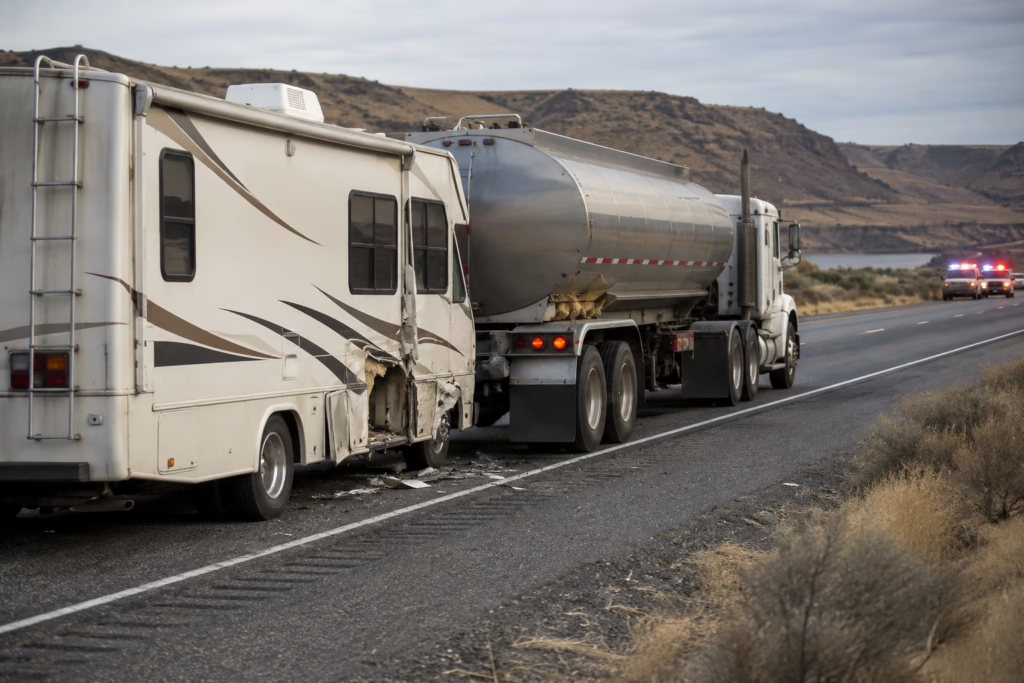
A serious I-90 Vantage RV crash left two passengers injured on November 6, 2026, after a recreational vehicle rear-ended a tanker truck in Kittitas County, Washington. According to news reports citing the Washington State Patrol, one passenger was airlifted to a hospital while another was transported for medical treatment. The RV driver was reportedly cited for distracted driving.
The collision highlights the dangers of driver inattention and raises important questions about liability, insurance coverage, and the legal rights of passengers injured in Washington motor vehicle accidents.
What Happened in the I-90 Vantage RV Crash?
According to NewsRadio 560 KPQ, the collision occurred at approximately 3:35 p.m. on Friday, November 6, 2026, along westbound Interstate 90 near Vantage, Washington.
The crash involved a recreational vehicle driven by a 52-year-old Tacoma resident and a tanker truck operated by a 78-year-old Clarkston resident.
Washington State Patrol investigators reported that the RV struck the rear of the tanker truck.
Two passengers traveling in the RV, both from Sandpoint, Idaho, were injured:
- A 43-year-old passenger was airlifted to a hospital in Wenatchee.
- A 48-year-old passenger was transported to a hospital in Ellensburg.
Neither driver was reported injured.
Investigators reportedly determined that drugs and alcohol were not contributing factors. Instead, authorities attributed the collision to the RV driver’s inattention and issued a distracted driving citation.
The full extent of the passengers’ injuries has not been publicly confirmed.
Distracted Driving and Washington Accident Liability
Distracted driving is a serious concern on Washington highways, particularly when large vehicles such as recreational vehicles and commercial trucks are involved.
A momentary lapse in attention can prevent a driver from recognizing slowing traffic, maintaining a safe following distance, or responding to changing roadway conditions.
Washington’s Distracted Driving Laws
Washington has specific statutes addressing driver distraction.
Under RCW 46.61.672 — Using a Personal Electronic Device While Driving, drivers generally cannot use handheld personal electronic devices while operating motor vehicles on public highways, subject to certain statutory exceptions.
Washington also prohibits dangerously distracted driving under RCW 46.61.673 — Dangerously Distracted Driving.
That law addresses activities unrelated to the actual operation of a motor vehicle that interfere with a driver’s ability to operate safely.
Examples of potentially distracting activities include:
- Looking at a cellphone or electronic device.
- Adjusting navigation or entertainment equipment.
- Reaching for objects inside the vehicle.
- Interacting with passengers.
- Looking away from traffic for an extended period.
The publicly available information about the Vantage collision does not establish precisely what distracted the RV driver. A distracted driving citation should not be interpreted as confirmation that cellphone use caused the accident.
Does a Distracted Driving Citation Prove Negligence?
A traffic citation can be important evidence in a personal injury investigation, but it does not automatically establish civil liability.
Under Washington law, an injured person generally must demonstrate that another party owed a duty of reasonable care, breached that duty, and caused compensable injuries.
Washington also addresses the relationship between statutory violations and negligence under RCW 5.40.050 — Breach of Duty.
Generally, a violation of a statute, ordinance, or administrative rule is not negligence per se, although evidence of a violation may be considered when determining negligence.
In a collision involving alleged distracted driving, relevant evidence may include:
- Washington State Patrol collision reports.
- Witness statements.
- Photographs and vehicle damage.
- Electronic records, when legally obtainable.
- Roadway and weather conditions.
- Available vehicle data.
A thorough investigation can help establish whether driver inattention contributed to the collision and resulting injuries.
Can Passengers Injured in an RV Accident Seek Compensation?
Passengers injured because of another person’s negligence may have the right to seek financial compensation.
Unlike drivers, passengers generally are not responsible for operating the vehicle in which they are traveling. However, every injury claim depends on its particular facts.
A passenger may potentially pursue a claim against the driver of the vehicle in which they were riding, another negligent driver, or another legally responsible party.
In the Vantage collision, authorities reportedly identified the RV driver’s inattention as the cause. That finding may be relevant to a passenger injury claim, although civil responsibility must be evaluated independently.
What Compensation May Be Available?
Depending on the circumstances, an injured passenger may be entitled to pursue damages for:
- Emergency medical transportation and hospital treatment.
- Past and reasonably anticipated future medical expenses.
- Lost wages and reduced earning capacity.
- Physical pain and suffering.
- Emotional distress associated with the injuries.
- Rehabilitation and ongoing medical care.
- Other legally recoverable losses.
The amount of compensation depends on the severity of the injuries, supporting evidence, available insurance coverage, and applicable legal defenses.
What If a Passenger Was Partially at Fault?
Washington follows a comparative fault system.
Under RCW 4.22.005 — Effect of Contributory Fault, a claimant’s contributory fault generally does not completely bar recovery. Instead, damages are reduced in proportion to the claimant’s legally attributable fault.
For example, if a person sustains $100,000 in damages but is found 20% responsible, the recoverable damages would generally be reduced to $80,000, before considering other applicable legal issues.
Importantly, merely being a passenger in a vehicle operated negligently does not automatically make that passenger responsible for the driver’s conduct.
What If the Passenger Was Not Wearing a Seatbelt?
Washington law also contains specific protections concerning seatbelt evidence.
Under RCW 46.61.688 — Safety Belts and Child Restraint Systems, evidence of failure to wear a safety belt generally is not admissible in a civil action for damages.
As a result, an insurance company cannot simply assume that a passenger loses the right to compensation because the passenger was not wearing a seatbelt.
The statute contains detailed requirements and exceptions, so individual circumstances should be evaluated carefully.
Why RV and Commercial Truck Collisions Can Cause Serious Injuries
Recreational vehicles have different handling characteristics than ordinary passenger cars.
Their size, weight, height, and braking characteristics can create additional challenges, especially at interstate highway speeds.
Commercial tanker trucks are also large, heavy vehicles. A collision between an RV and a tanker truck can involve substantial forces, even when one vehicle is moving relatively slowly.
Possible injuries from serious highway collisions include:
- Traumatic brain injuries and concussions.
- Neck and spinal cord injuries.
- Broken bones.
- Internal injuries.
- Shoulder and back injuries.
- Soft-tissue injuries requiring extended treatment.
These are general examples of injuries associated with serious vehicle collisions, not confirmed diagnoses of the people involved in the November 6 Vantage crash.
What Should Injured Passengers Do After a Washington Highway Accident?
After a serious accident, injured passengers should prioritize medical care while taking reasonable steps to protect their legal rights.
Seek Prompt Medical Treatment
Some injuries are immediately apparent, while others may become noticeable hours or days after a collision.
Prompt evaluation can identify medical concerns and establish documentation connecting injuries to the accident.
Preserve Important Evidence
Useful evidence may include photographs, witness information, medical records, insurance correspondence, and the official collision report.
Depending on the circumstances, an attorney may also seek preservation of relevant vehicle data, electronic records, or other evidence.
Understand Available Insurance Coverage
A passenger injury claim may involve several types of insurance coverage.
Potential sources of compensation can include the at-fault driver’s liability insurance, applicable personal injury protection benefits, and uninsured or underinsured motorist coverage.
Washington’s mandatory automobile liability insurance requirements are addressed in RCW 46.29.090 — Motor Vehicle Liability Policy.
Washington also regulates personal injury protection and uninsured or underinsured motorist coverage under RCW 48.22.085 and RCW 48.22.030, respectively.
The availability of these benefits depends on the policies involved, the type of vehicle, statutory requirements, and other circumstances.
Avoid Rushing Into an Insurance Settlement
An insurance company may offer a settlement before the injured person’s medical condition has stabilized.
Accepting a final settlement and signing a release may prevent additional recovery for injuries arising from the same collision.
Injured passengers should understand the extent of their injuries and potential future medical needs before resolving their claims.
How Long Do Injured Passengers Have to File a Washington Personal Injury Lawsuit?
Washington generally provides a three-year statute of limitations for personal injury lawsuits.
This deadline is established under RCW 4.16.080 — Actions Limited to Three Years.
For an accident occurring on November 6, 2026, the ordinary three-year period would generally run to November 6, 2029.
However, exceptions, tolling provisions, or different procedural requirements may apply depending on the circumstances.
Waiting until the deadline approaches can also create practical difficulties. Witnesses may become harder to locate, records may be lost, and physical evidence may no longer be available.
Consulting an attorney promptly can help preserve evidence and identify applicable deadlines.
Who May Be Responsible for an I-90 Rear-End Collision?
Rear-end collisions frequently involve questions about driver attention, following distance, braking, and roadway conditions.
Washington requires drivers to maintain a reasonable and prudent following distance under RCW 46.61.145 — Following Too Closely.
The appropriate following distance depends on factors such as vehicle speed, traffic conditions, and roadway circumstances.
Although the following driver may be negligent in a rear-end collision, liability is not automatically established solely because one vehicle struck another from behind.
In the November 6 Vantage crash, investigators reportedly attributed the collision to the RV driver’s inattention.
That determination may be significant evidence in any resulting personal injury claim, but the full circumstances would need to be examined before reaching a final civil liability conclusion.
Contact a Washington Personal Injury Attorney
The November 6 collision on Interstate 90 near Vantage demonstrates how quickly an ordinary highway trip can result in serious injuries.
Passengers injured in RV and commercial vehicle accidents may face substantial medical expenses, lost income, and uncertainty about available insurance coverage.
Understanding Washington negligence law, comparative fault, and applicable insurance policies can be essential when evaluating a potential claim.
Blanford Law helps people understand their rights following Washington motor vehicle accidents and other personal injury matters.
Contact Blanford Law today at ken@blanfordlaw.com or 253-720-9304 for guidance on your legal matter.
Additional Resources
Additional Resources
For more information about Washington motor vehicle accidents, passenger injury claims, distracted driving, and legal rights following serious collisions, explore these related articles from Blanford Law.
1. Quincy SR-28 Crash: Child Passenger Injuries
This article examines a collision near Quincy, Washington, involving child passenger injuries and discusses the legal rights of injured passengers, liability, and potential compensation under Washington law.
2. Washington DUI License Suspension
Learn how Washington’s DUI laws affect driving privileges, the administrative license suspension process, and the legal consequences of impaired driving.
3. Distracted Driving Accident Lawyer — Legal Help in Washington State
Distracted driving can lead to devastating collisions. This article explains Washington distracted driving laws, negligence, and the legal options available to people injured by inattentive motorists.
4. Young Child Seriously Injured in Rollover Crash Near Snoqualmie Pass
A serious rollover collision on Interstate 90 injured a young passenger near Snoqualmie Pass. This article examines passenger safety, negligence, and legal considerations following serious Washington highway accidents.
5. SR 18 Motorcycle Crash Near Tiger Mountain Summit Leaves Passenger Seriously Injured
This article examines a collision involving a motorcycle and semi-truck near Tiger Mountain, highlighting passenger injury claims, commercial vehicle liability, and Washington’s comparative fault rules.
Disclaimer: This article is for general informational purposes and does not constitute legal advice. Accident details are based on publicly reported information and may change as additional facts become available.