
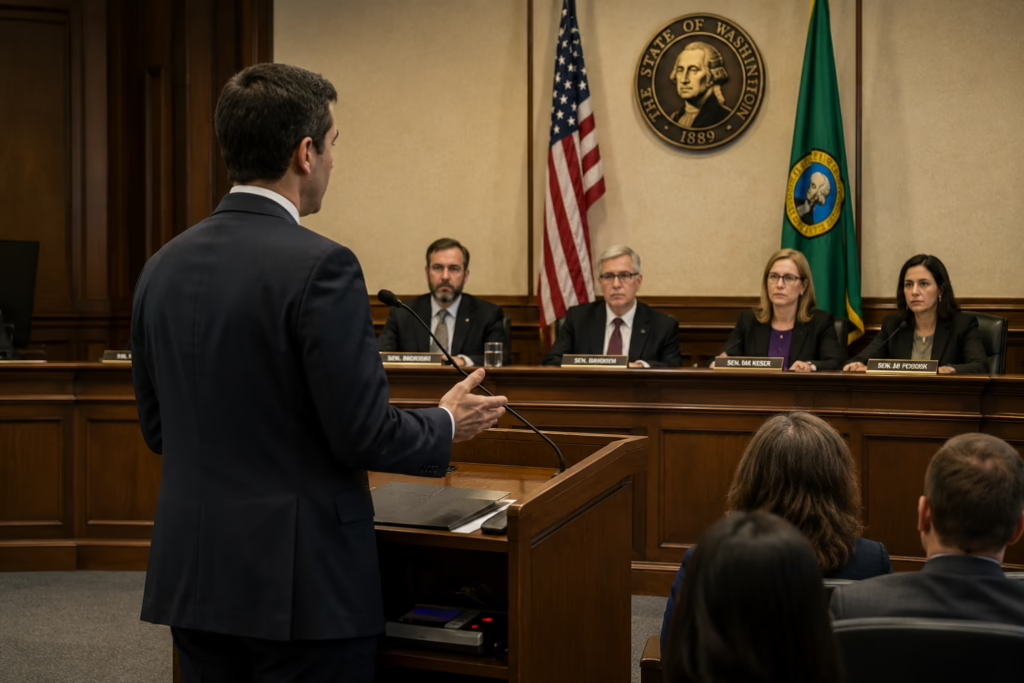
Attorneys often represent clients in court, but legal advocacy extends well beyond the courtroom. RPC 3.9 Washington lawyer responsibilities apply when attorneys appear before legislative bodies or administrative agencies during nonadjudicative proceedings. These proceedings often involve public policy, rulemaking, or legislative decisions rather than disputes between opposing parties.
Washington’s Rules of Professional Conduct (RPC) require lawyers to maintain the same level of honesty and professionalism in these settings as they do before a judge. Understanding RPC 3.9 helps both attorneys and clients appreciate the ethical obligations that accompany government advocacy.
What Is RPC 3.9?
RPC 3.9 is titled “Advocate in Nonadjudicative Proceedings.” It provides:
A lawyer representing a client before a legislative body or administrative agency in a nonadjudicative proceeding must disclose that the lawyer is appearing in a representative capacity and must comply with the ethical duties contained in RPC 3.3(a)-(e), RPC 3.4(a)-(c), and RPC 3.5.
Although these proceedings are not traditional lawsuits, they often influence laws, regulations, and public policy. As a result, lawyers are expected to uphold many of the same ethical standards that govern courtroom advocacy.
What Is a Nonadjudicative Proceeding?
A nonadjudicative proceeding is one in which a government body is making policy or creating rules rather than deciding a legal dispute between parties.
Examples include:
- City council meetings considering new ordinances
- County commission hearings
- State legislative committee hearings
- Administrative rulemaking hearings
- Public hearings on proposed regulations
- Executive agency policy discussions
In these settings, attorneys may present evidence, explain legal issues, or advocate for a client’s position regarding proposed governmental action.
Lawyers Must Disclose Their Representative Capacity
One of the core requirements of RPC 3.9 is transparency.
An attorney appearing before a legislative or administrative body must make clear that they are representing a client rather than speaking solely on their own behalf.
This disclosure promotes:
- Transparency in governmental decision-making
- Public confidence
- Fair consideration of competing viewpoints
- Honest communication with decision-makers
Government officials should always know when an attorney is advocating on behalf of another person, business, or organization.
Ethical Duties Continue Outside the Courtroom
RPC 3.9 Washington Lawyer Obligations
Although a legislative hearing is different from a courtroom trial, attorneys remain bound by important ethical obligations.
These include duties found in:
RPC 3.3 – Candor Toward the Tribunal
Lawyers must:
- Avoid making false statements
- Correct material misstatements
- Avoid presenting false evidence
- Maintain honesty throughout the proceeding
Government bodies rely upon accurate legal and factual information when making policy decisions.
RPC 3.4 – Fairness to Others
Attorneys may not:
- Unlawfully obstruct access to evidence
- Alter or destroy evidence
- Falsify documents
- Assist witnesses in providing false testimony
Professional fairness remains essential even when the proceeding is legislative rather than judicial.
RPC 3.5 – Impartiality and Decorum
Lawyers must conduct themselves professionally and avoid improper attempts to influence decision-makers.
Respectful advocacy helps preserve confidence in governmental institutions.
Why These Rules Matter
The comments to RPC 3.9 explain that legislative bodies and administrative agencies, much like courts, rely on the integrity of attorneys appearing before them.
Although legislators and agency officials ultimately make policy decisions, they often depend upon legal analysis, factual presentations, and expert testimony submitted by attorneys.
Misleading information can affect:
- New laws
- Administrative regulations
- Licensing rules
- Public safety standards
- Business regulations
- Community planning
For that reason, Washington expects attorneys to provide honest and reliable advocacy.
When RPC 3.9 Does Not Apply
The rule is intentionally limited.
According to Comment 3, RPC 3.9 generally does not apply when an attorney is involved in:
- Negotiating with a government agency
- Applying for permits or licenses
- Filing tax returns
- Routine regulatory compliance
- Government investigations
- Agency examinations of a client’s affairs
Instead, those situations are generally governed by RPC 4.1 through RPC 4.4, which address truthfulness and communications with third parties.
The distinction depends largely on whether the lawyer is participating in an official hearing or meeting where evidence or argument is being presented to a governmental decision-making body.
Legislative Advocacy Requires Professional Integrity
Attorneys often help shape laws and regulations that affect businesses, individuals, and communities throughout Washington.
Whether speaking before:
- The Washington State Legislature,
- A city council,
- A county commission,
- Or a state administrative agency,
lawyers serve an important role in ensuring decision-makers receive accurate legal information.
RPC 3.9 reinforces that advocacy outside the courtroom still demands honesty, transparency, fairness, and professionalism.
Why Clients Should Care
Clients frequently hire attorneys to advocate before government agencies because these proceedings can have lasting financial and legal consequences.
Ethical representation helps ensure that:
- Government officials receive accurate information.
- Clients maintain credibility throughout the process.
- Advocacy remains effective without violating professional rules.
- Decisions are based on truthful and reliable evidence.
Experienced legal counsel understands not only the substantive law but also the ethical obligations that accompany appearances before governmental bodies.
Contact Blanford Law
If you have questions about legal ethics, administrative proceedings, or representation before a Washington government agency, Contact Blanford Law today at ken@blanfordlaw.com or 253-720-9304 for guidance on your legal matter.
Additional Resources
- IRLJ 5.1 Appeals in Washington
Learn how IRLJ 5.1 governs appeals of traffic infraction decisions in Washington and what drivers should know about the appellate process. - RPC 3.9: Advocate in Nonadjudicative Proceedings
Explore Washington Rule of Professional Conduct 3.9 and the ethical obligations attorneys owe when representing clients before legislative bodies and administrative agencies. - Traffic Infraction Appeals in Washington
Understand the process for appealing a traffic infraction decision, including important deadlines and procedural requirements. - IRLJ 4.2: Failure to Pay a Traffic Infraction
Learn what happens when a traffic infraction is not paid on time and the potential legal consequences under Washington law. - Washington GR 37 Rule: Eliminating Implicit Bias in Jury Selection
Read about General Rule 37 and how Washington courts address implicit bias during jury selection to promote fair and impartial trials.