
November 3, 2026
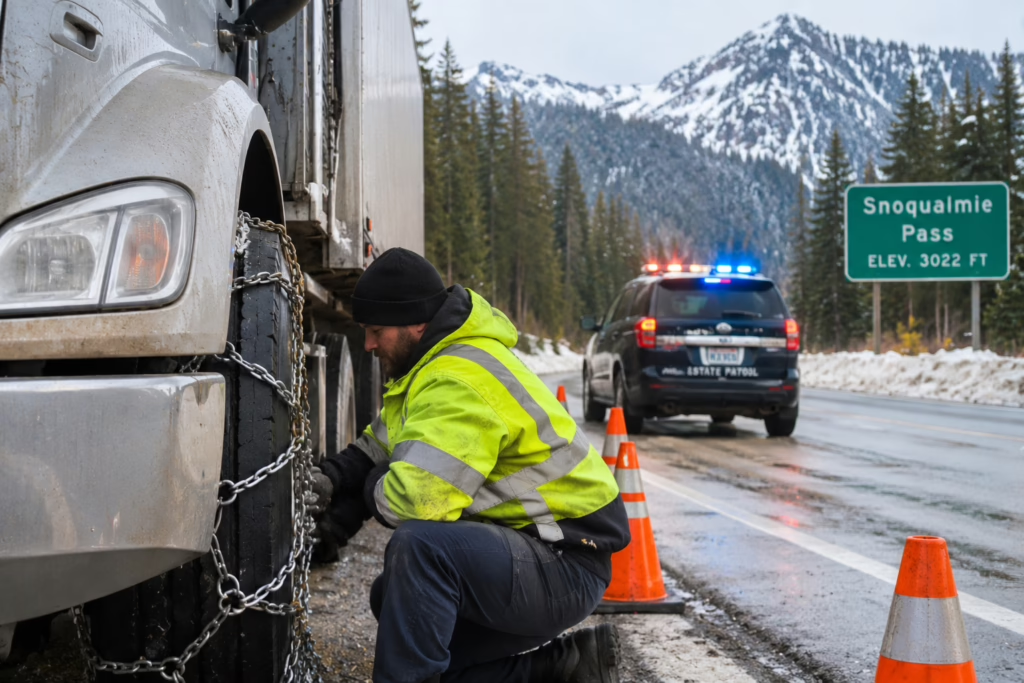
Drivers traveling over Interstate 90 this winter should be aware that Snoqualmie Pass chain requirements can apply even when there is no snow on the roadway. The Washington State Patrol (WSP) is emphasizing that point with a two-day commercial vehicle chain enforcement operation on November 3–4, 2026.
For commercial truck drivers traveling between Seattle, Cle Elum, and Ellensburg, Washington’s winter chain laws are more than a seasonal precaution. Failing to carry or use required tire chains can result in traffic violations and potentially contribute to serious highway accidents.
Washington State Patrol Launches Chain Enforcement on Snoqualmie Pass
According to a November 2, 2026, announcement from the Washington State Patrol, troopers are conducting a two-day enforcement emphasis on Interstate 90 to ensure commercial vehicles comply with Washington’s seasonal tire chain requirements.
The operation comes at a time when Snoqualmie Pass has experienced little or no snowfall. However, Washington law does not require snow to be present before certain commercial vehicles must carry tire chains.
The enforcement effort focuses on making sure commercial drivers have the proper equipment before winter storms create hazardous travel conditions.
Snoqualmie Pass is a major freight transportation route connecting Western and Eastern Washington. A commercial truck that becomes disabled or loses traction on a mountain highway can create dangerous conditions for hundreds of other motorists.
By checking compliance early in the winter season, WSP hopes to reduce preventable incidents and improve highway safety.
What Are Washington’s Snoqualmie Pass Chain Requirements?
Washington requires certain vehicles to carry tire chains while traveling on designated mountain highways between November 1 and April 1.
According to the Washington State Department of Transportation’s commercial vehicle chain requirements, vehicles weighing more than 10,000 pounds must carry the required chains on designated routes, including Interstate 90 between North Bend and Ellensburg.
This requirement applies during the designated winter season regardless of whether snow or ice is present.
Carrying Chains vs. Installing Chains
One important distinction under Washington law is the difference between carrying chains and actually installing them.
Carrying chains: Covered vehicles must have the required tire chains available while traveling on designated mountain highways during the winter season.
Installing chains: Drivers must install chains when posted highway restrictions require them.
A commercial truck driver traveling over Snoqualmie Pass on a clear November afternoon may not need to install chains. However, the driver may still be legally required to carry them.
The number and placement of chains depend on the vehicle’s weight, axle configuration, and other applicable requirements.
Do Passenger Vehicles Need Chains?
Passenger vehicles are subject to different requirements.
Generally, ordinary passenger vehicles are not subject to the same seasonal chain-carrying mandate as heavier vehicles. However, they must comply with applicable posted traction restrictions.
When signs indicate that chains are required, drivers may need to install approved traction devices before proceeding.
Certain all-wheel-drive and four-wheel-drive vehicles may qualify for exemptions under specific restrictions, but drivers must still carry appropriate chains or approved alternatives when required.
Motorists should check current WSDOT mountain pass conditions before beginning their trip.
What Is the Penalty for Violating Washington’s Tire Chain Laws?
Washington law provides specific penalties for failing to obey posted tire chain and traction equipment requirements.
Under RCW 47.36.250, the Washington State Department of Transportation has authority to establish special tire, chain, and traction equipment requirements when highway conditions make additional safety precautions necessary.
The statute also authorizes the placement of signs notifying motorists when those requirements apply.
Drivers who fail to obey a requirement imposed under this statute commit a traffic infraction subject to a $500 penalty, including statutory assessments.
It is important to distinguish a violation of a posted chain requirement from failing to carry chains during the seasonal period. Although both may result in enforcement action, the applicable violation and penalty depend on the specific legal requirement.
For commercial drivers, failing to comply may also lead to delays, inspections, and other consequences.
Can a Truck Driver Be Liable for an Accident Caused by Failing to Use Chains?
Failing to comply with Washington’s chain requirements can have consequences beyond a traffic ticket.
Commercial trucks can weigh many times more than passenger vehicles. When a large truck loses traction on a mountain highway, the results can be devastating.
A tractor-trailer sliding across Interstate 90 may collide with several vehicles, block traffic, or force other drivers to take dangerous evasive action.
Common winter truck accidents include:
- Jackknife accidents involving tractor-trailers.
- Rear-end collisions caused by inadequate stopping distances.
- Trucks sliding into neighboring lanes.
- Multi-vehicle collisions on icy highways.
- Loss-of-control accidents on steep mountain grades.
When a commercial truck driver fails to install chains despite a posted requirement, that failure may become important evidence in a personal injury claim.
Washington Law and Negligence After a Winter Accident
Under Washington law, an injured person generally must prove that another party owed a duty of reasonable care, breached that duty, and caused compensable harm.
Washington also addresses how violations of safety laws may be considered in negligence cases.
Under RCW 5.40.050, a violation of a statute or regulation generally may be considered evidence of negligence, but does not automatically establish negligence.
For example, if a truck driver ignores a posted chain requirement and subsequently loses control on an icy section of Interstate 90, the failure to comply may be relevant to determining whether the driver acted reasonably.
Other factors may include excessive speed, poor vehicle maintenance, inadequate driver training, or failure to account for changing weather conditions.
Depending on the circumstances, the trucking company may also bear responsibility for an accident involving its driver.
However, a chain violation alone does not automatically establish liability. The injured person must still establish the required elements of a negligence claim, including causation.
Why Winter Truck Accidents Are a Serious Concern on Interstate 90
Snoqualmie Pass connects the Seattle metropolitan area with Kittitas County and communities throughout Eastern Washington.
The route is heavily traveled by commercial trucks, delivery vehicles, commuters, and recreational travelers.
Winter weather can change rapidly across the Cascade Mountains. A driver leaving Seattle in mild conditions may encounter freezing temperatures, icy pavement, or heavy snowfall near the summit.
Likewise, conditions around Cle Elum and Ellensburg may differ significantly from those at Snoqualmie Pass.
Commercial truck accidents are particularly concerning because of the vehicles’ size, weight, and stopping distances.
Even when a highway appears clear, shaded areas, bridges, and elevated road surfaces can become slippery when temperatures fall.
These conditions make compliance with Washington’s winter traction requirements especially important.
The Washington State Patrol’s November 2026 enforcement operation serves as a reminder that winter highway safety begins before the first major snowstorm.
What Should You Do After a Truck Accident on Snoqualmie Pass?
If you are injured in a truck accident on Interstate 90, taking appropriate steps after the collision may help protect your health and legal rights.
First, seek medical attention and report the accident to law enforcement when required.
If it is safe to do so, photograph the vehicles, roadway conditions, nearby traffic signs, and any visible tire chains or traction equipment.
You should also preserve information about the truck driver, trucking company, witnesses, and responding law enforcement officers.
In commercial truck accident cases, additional evidence may be particularly important, including:
- Truck maintenance and inspection records.
- Driver qualification and training records.
- Electronic logging device information.
- Vehicle event data.
- Weather and roadway reports.
- Company safety policies.
- Records showing whether required chains were available or installed.
Some of this evidence may be difficult to obtain without legal assistance.
An attorney experienced in Washington personal injury law can evaluate the circumstances of the collision, investigate potential negligence, and help determine whether compensation may be available.
Injured in a Snoqualmie Pass or Interstate 90 Accident? Contact Blanford Law
Washington’s winter chain requirements are intended to reduce dangerous highway conditions and protect motorists traveling through the Cascade Mountains.
The Washington State Patrol’s November 2026 enforcement effort underscores the importance of complying with these rules even when there is no snow on the ground.
For people injured in commercial truck accidents, determining whether a driver followed applicable safety requirements may be an important part of investigating the collision.
Blanford Law assists injured individuals with personal injury matters throughout Washington, including accidents involving commercial trucks and other vehicles on Interstate 90.
Contact Blanford Law today at ken@blanfordlaw.com or 253-720-9304 for guidance on your legal matter.
Additional Resources
For more information about Washington traffic laws, mountain highway accidents, personal injury claims, and other legal issues, explore these articles from Blanford Law.
Washington Traffic Safety and Personal Injury
Washington’s Move Over Law and I-90 Crashes
Learn about Washington’s Move Over Law, its role in protecting emergency responders and roadside workers, and the potential legal consequences of failing to comply.
Washington Mountain Pass Accidents: Understanding the Risks and Your Legal Rights
Explore the dangers of driving through Washington’s mountain passes, including Snoqualmie Pass, and how weather conditions, driver negligence, and roadway hazards can affect personal injury claims.
Additional Washington Legal Topics
Washington Legal Malpractice Claims
Understand when an attorney’s professional negligence may give rise to a legal malpractice claim and what individuals should know about protecting their rights.
Washington Medical Website Privacy
Learn about privacy concerns involving medical websites, the collection of sensitive health information, and potential protections under Washington law.
Washington Community Custody Conditions
Review Washington’s community custody requirements, common supervision conditions, and the possible legal consequences of violating those conditions.