
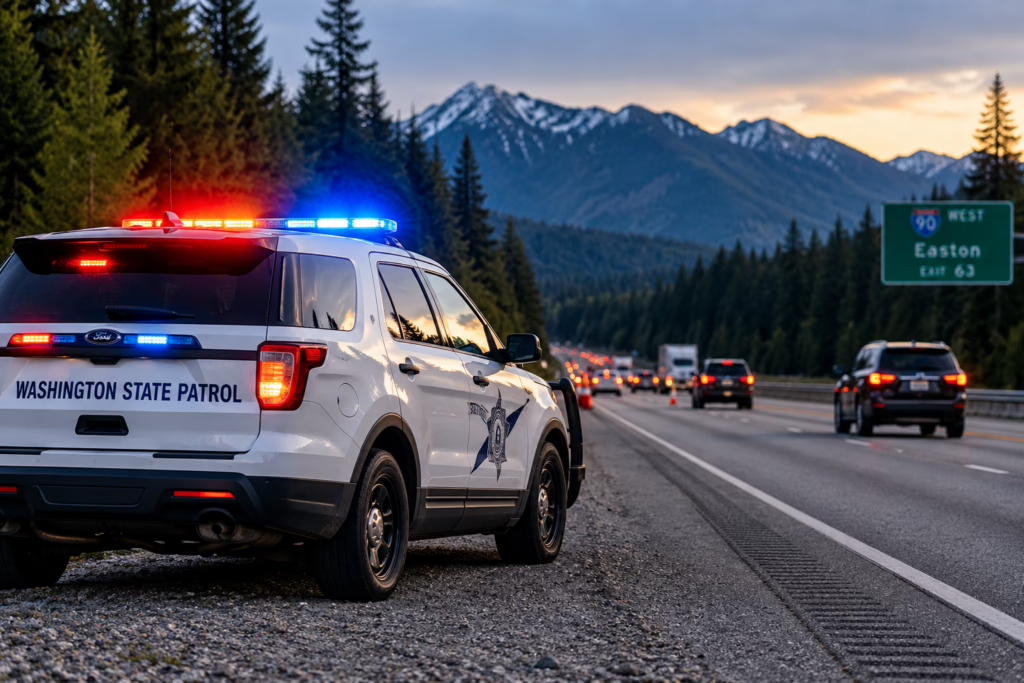
A Washington State Patrol trooper was injured after a pickup truck struck his patrol vehicle along Interstate 90 near Easton, Washington, on October 21, 2026. The collision highlights the importance of the Washington Move Over Law, which requires motorists to take specific precautions when approaching emergency vehicles and roadside workers.
The incident serves as a reminder that failing to slow down or move over near emergency responders can have serious consequences, including injuries, traffic citations, and potential criminal charges.
For drivers traveling through Kittitas County and across Washington State, understanding these requirements is essential for protecting emergency personnel and avoiding preventable accidents.
Washington State Trooper Injured in I-90 Collision Near Easton
According to an October 22 report from NewsRadio 560 KPQ, the collision occurred at approximately 7:45 p.m. on Wednesday, October 21, 2026, in the westbound lanes of Interstate 90 near Exit 63 in Kittitas County.
Washington State Patrol Trooper Jaden Siller, 24, was assisting with an earlier collision when a Chevrolet pickup truck struck his marked patrol vehicle.
The patrol vehicle reportedly had its emergency lights activated when the collision occurred.
The pickup truck was driven by Bradley W. Cameron, 71, of Port Angeles, Washington.
Trooper Siller was transported to Kittitas Valley Hospital in Ellensburg for treatment of injuries described as minor.
The pickup driver was not injured.
According to the initial Washington State Patrol investigation, the pickup driver failed to yield to the patrol vehicle. Authorities also reported that drugs and alcohol were not contributing factors.
As of the initial reports published October 22, no citation had been announced, and the investigation remained ongoing.
The collision caused significant traffic disruptions along westbound Interstate 90.
Although the trooper’s reported injuries were not life-threatening, the incident demonstrates the dangers emergency responders face while assisting motorists on Washington highways.
Source: NewsRadio 560 KPQ, October 22, 2026.
What Is the Washington Move Over Law?
Washington law requires drivers approaching certain stopped emergency vehicles, tow trucks, roadside assistance vehicles, and highway maintenance vehicles to slow down and move over when it is safe to do so.
The requirements are established under RCW 46.61.212, which governs driving through emergency and work zones.
Drivers Must Move Over When Safe
On highways with at least two lanes traveling in the same direction, motorists approaching qualifying emergency or roadside vehicles must:
- Proceed cautiously when approaching the emergency zone.
- Reduce their speed.
- Move into another lane away from the emergency vehicle when it is safe and practical.
- Remain alert for emergency personnel, pedestrians, and unexpected traffic conditions.
Importantly, drivers should never make an unsafe lane change simply to comply with the law.
What Happens When Drivers Cannot Move Over?
When changing lanes is unsafe, Washington law requires motorists to proceed cautiously and reduce their speed.
Under RCW 46.61.212, drivers who cannot safely move over must reduce their speed to at least 10 mph below the posted speed limit.
When the posted speed limit exceeds 60 mph, the law instead requires drivers to reduce their speed to no more than 50 mph.
Drivers must also obey any lower speed limits or traffic controls applicable to the area.
These requirements help protect police officers, firefighters, emergency medical personnel, tow truck operators, and highway workers.
Washington’s Emergency Zone Extends Beyond the Stopped Vehicle
Washington law defines qualifying emergency and work zones to include adjacent roadway lanes extending 200 feet before and 200 feet after certain stopped or slow-moving vehicles displaying the required warning signals.
This means drivers should begin responding well before reaching the emergency vehicle.
Waiting until the last moment to slow down or change lanes can create dangerous conditions for everyone involved.
What Are the Penalties for Violating Washington’s Move Over Law?
Failing to comply with Washington’s emergency-zone requirements can result in significant legal consequences.
Increased Traffic Penalties
Under RCW 46.61.212, violations of the emergency-zone law carry a monetary penalty equal to twice the otherwise applicable traffic-infraction penalty.
The statute also prohibits reducing, waiving, or suspending that enhanced penalty.
Criminal Charges for Endangering Emergency Workers
More serious conduct can lead to criminal prosecution.
A driver who operates a vehicle in an emergency or work zone in a manner that endangers, or is likely to endanger, an emergency or work-zone worker or property may face a charge of reckless endangerment of emergency or work-zone workers.
Under Washington law, this offense is classified as a gross misdemeanor.
A conviction also requires a 60-day driver’s license suspension.
However, not every collision involving an emergency vehicle automatically establishes criminal liability.
Investigators must evaluate the circumstances, and prosecutors must establish the elements of any criminal offense.
In the Easton collision, the initial reports indicated that the investigation remained open and that no citation had yet been announced.
Who Is Liable When a Driver Strikes a Stopped Emergency Vehicle?
When a motorist strikes a stopped emergency vehicle, determining civil liability requires examining the driver’s actions and the surrounding circumstances.
Relevant considerations may include whether the driver:
- Failed to maintain a proper lookout.
- Was traveling too fast for the conditions.
- Failed to move over when it was safe.
- Did not reduce speed as required by law.
- Was distracted or otherwise driving negligently.
- Ignored emergency lights or traffic-control warnings.
Evidence such as dashcam footage, witness statements, vehicle damage, and collision reports may help establish what happened.
Can Violating the Move Over Law Support a Personal Injury Claim?
A violation of Washington’s Move Over Law may be relevant evidence in a negligence claim.
However, Washington law does not generally treat a traffic-law violation as automatically establishing negligence in a civil case.
Instead, the violation may be considered alongside other evidence when determining whether a driver failed to exercise reasonable care.
An injured person must also establish that the defendant’s legally actionable conduct caused the claimed injuries and damages.
Washington’s Comparative Fault Rules
Washington follows a comparative fault system under RCW 4.22.005.
This means an injured person’s compensation may be reduced according to their percentage of responsibility for an accident.
For example, if an injured motorist sustained $100,000 in legally recoverable damages but was found 20% responsible, the damages award would generally be reduced to $80,000.
Each accident must be evaluated individually.
What Compensation May Be Available After a Highway Accident?
People injured by negligent drivers may be entitled to pursue compensation for losses resulting from a collision.
Depending on the circumstances, recoverable damages may include medical expenses, future treatment costs, lost wages, diminished earning capacity, pain and suffering, and other legally recognized losses.
When an on-duty law enforcement officer is injured, additional issues involving workers’ compensation and potential third-party liability may arise.
The availability of a civil claim depends on the specific facts, applicable insurance coverage, and Washington law.
What Should Drivers Do When Approaching Emergency Vehicles on I-90?
Interstate 90 is one of Washington’s busiest transportation corridors, connecting communities across the Cascade Mountains.
Conditions near Easton and Snoqualmie Pass can change quickly because of weather, limited visibility, traffic congestion, and highway incidents.
Drivers approaching emergency vehicles should remain especially cautious.
Five Important Highway Safety Practices
1. Watch for emergency lights. Scan the roadway ahead for flashing lights, stopped vehicles, and unexpected lane closures.
2. Reduce speed early. Begin slowing down as soon as an emergency scene becomes visible.
3. Move over when safe. Change lanes away from the emergency vehicle when traffic conditions permit.
4. Avoid distractions. Put away electronic devices and remain focused on surrounding traffic.
5. Give emergency responders room. Maintain a safe distance from officers, firefighters, tow truck operators, and other roadside personnel.
These precautions can reduce the likelihood of serious collisions.
Injured in an Interstate 90 Accident? Understand Your Legal Options
The October 21 collision near Easton illustrates how quickly a routine roadside emergency can become dangerous.
While the Washington State Patrol continues investigating the circumstances of the incident, the accident reinforces the importance of following Washington’s emergency-zone traffic laws.
Drivers throughout Kittitas County, including those traveling near Easton, Cle Elum, Roslyn, and Ellensburg, have a responsibility to operate their vehicles safely around emergency responders.
Individuals injured in highway collisions may have legal options when another driver’s negligence contributes to their injuries.
Washington generally provides a three-year statute of limitations for personal injury lawsuits under RCW 4.16.080, although exceptions and special procedural requirements may apply.
Speaking with an attorney can help injured individuals understand their rights, evaluate available evidence, and identify applicable deadlines.
Contact Blanford Law
If you or a loved one has been injured in a motor vehicle accident in Kittitas County or elsewhere in Washington State, Blanford Law can help you understand your legal options.
Contact Blanford Law today at ken@blanfordlaw.com or 253-720-9304 for guidance on your legal matter.
Additional Resources
Learn more about Washington traffic laws, highway safety, and your legal rights after a motor vehicle accident with these related articles from Blanford Law.
1. Washington Semi-Truck Crash: State Patrol Vehicle Struck on I-90
A semi-truck collision involving Washington State Patrol officers in Kittitas County highlights the dangers emergency responders face along Interstate 90 and the importance of Washington’s Move Over Law.
2. Elderly Driver Rear-Ends Trooper SUV: Legal Responsibility in Washington
Explore the legal responsibilities of Washington drivers following a collision involving an elderly motorist and a State Patrol SUV, including negligence, driver awareness, and potential liability.
3. Understanding Moving Violations Under WAC 308-104-160 in Washington
Learn how Washington classifies moving violations, how traffic infractions can affect your driving record, and why following traffic safety laws is essential.
4. Driving with Wheels Off Roadway in Washington — RCW 46.61.670
Understand Washington’s restrictions on driving along roadway shoulders, the exceptions permitted by law, and how improper driving maneuvers can contribute to highway accidents.
5. I-5 Thurston County Crash: Who May Be Liable When a Driver Stops on the Freeway?
Discover how Washington law determines fault when vehicles collide with stopped traffic on a highway, including the responsibilities of drivers approaching unexpected roadway hazards.
This article provides general information about Washington law and does not constitute legal advice. The collision remains subject to the findings of the investigating authorities.