
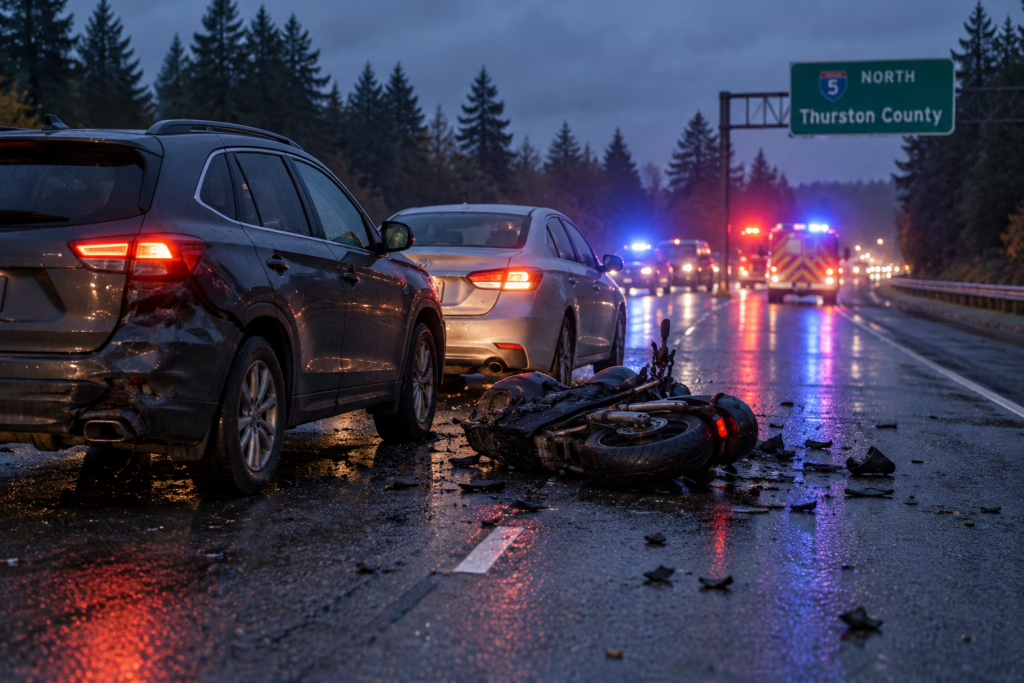
A recent Thurston County freeway crash involving three vehicles, including a motorcycle, illustrates how complicated fault can become when a driver unexpectedly stops on Interstate 5. According to a Washington State Patrol account reported by AOL, a 21-year-old Bremerton woman stopped on northbound I-5 north of Maytown after encountering an unidentified hazard in the roadway. A 69-year-old Tumwater driver and a 39-year-old motorcyclist from Battle Ground then collided with her vehicle. The Bremerton driver was injured and transported to Providence St. Peter Hospital in Olympia.
Although it can be tempting to assume that the driver who strikes another vehicle from behind is automatically responsible, Washington personal injury law requires a closer examination of what each driver did, what hazards were present, and whether those actions caused the collision.
What Happened in the Thurston County Freeway Crash?
According to the September 8, 2026 report, the collision occurred at approximately 8:20 p.m. on northbound Interstate 5, north of Maytown. Washington State Patrol reportedly said the Bremerton driver stopped because of an unidentified hazard in the roadway. The Tumwater driver and motorcyclist subsequently crashed into her vehicle. The collision blocked the roadway for approximately 90 minutes.
Those limited facts leave an important unanswered question from a personal injury perspective: Who was legally responsible for the crash?
The fact that one vehicle stopped does not by itself establish negligence. Likewise, the fact that another driver struck a stopped vehicle does not necessarily resolve the liability question.
Determining Liability After a Thurston County Freeway Crash
Washington drivers have a duty to operate their vehicles with reasonable care under the circumstances. That includes accounting for actual and potential hazards.
RCW 46.61.400 provides that motorists must drive at a speed that is reasonable and prudent under existing conditions. It also requires drivers to control their speed as necessary to avoid collisions while exercising due care.
Washington law also prohibits following another vehicle more closely than is reasonable and prudent considering traffic, speed, and highway conditions.
Those rules can become particularly important in a freeway collision involving a suddenly stopped vehicle.
Was the Initial Stop Reasonable?
One major issue would be why the first vehicle stopped.
The news report describes an unidentified hazard in the roadway but does not explain what the hazard was. If a reasonable driver confronted with the same hazard would have stopped to avoid a collision, the stop may have been justified.
If evidence instead showed that a driver stopped unnecessarily, unpredictably, or without reasonable care, the liability analysis could be different.
That is why investigators and personal injury attorneys may look beyond the simple fact that a vehicle stopped and examine evidence such as witness accounts, dash-camera recordings, physical evidence, vehicle data, photographs, and the State Patrol investigation.
Could the Following Drivers Share Responsibility?
The actions of the following motorists also matter.
Drivers must maintain sufficient control and following distance to respond to foreseeable changes in traffic. A driver who is traveling too fast for conditions, following too closely, distracted, or otherwise unable to respond reasonably to slowing or stopped traffic may bear some responsibility for a resulting collision.
Motorcycles deserve particular attention in crashes like this one. A motorcyclist has far less physical protection than someone inside a passenger vehicle. Even when another person walks away from a collision, a motorcycle rider can suffer serious injuries from the initial impact or from being thrown onto the roadway.
Washington’s Comparative Fault Rules
A three-vehicle collision does not necessarily have only one responsible party.
Washington uses a comparative fault system. Under RCW 4.22.005, fault attributable to an injured claimant generally reduces that person’s compensatory damages proportionately rather than automatically preventing recovery. Washington’s statutory definition of fault also considers negligent or reckless acts or omissions and their causal relationship to the damages.
For example, evidence in a multi-vehicle freeway collision could potentially support allegations that one driver made an unsafe stop while another was following too closely. The percentages would depend on the actual evidence; the news report alone does not establish those conclusions.
That distinction matters. An insurance company may try to place most or all responsibility on another driver, but its initial liability determination is not necessarily the final word.
Evidence Can Be Critical After a Multi-Vehicle I-5 Collision
Highway accident scenes can change rapidly. Vehicles are removed, debris is cleared, witnesses leave, and electronic recordings can be overwritten.
Potentially useful evidence may include:
- Washington State Patrol collision records and investigative materials
- Photographs and video of the vehicles and roadway
- Dash-camera footage
- Nearby traffic or surveillance cameras
- Witness statements
- Vehicle event data
- Cellphone records when legally relevant and obtainable
- Medical records documenting injuries
- Evidence identifying the reported roadway hazard
Washington law requires law enforcement officers who investigate qualifying collisions to submit an investigator’s report. Certain collision information is also available to people with a proper interest, including injured persons and their attorneys or insurers.
Preserving evidence early can be especially important when several drivers and insurance carriers may disagree about what happened.
What Compensation May Be Available After a Washington Car or Motorcycle Crash?
Someone injured because of another person’s negligence may be able to pursue compensation for losses caused by the collision. Depending on the circumstances and evidence, recoverable damages may include medical expenses, lost income, reduced earning capacity, property damage, and compensation for pain, disability, and other noneconomic harm.
The nature and value of a claim depend on the individual facts. An injury that initially appears minor can also develop into a more significant medical problem, making careful documentation important.
Washington generally imposes a three-year limitations period on actions for injury to a person under RCW 4.16.080. Other deadlines or procedural requirements can apply in particular circumstances, so an injured person should not assume that waiting until the end of that period is safe.
Injured in a Thurston County Freeway Accident?
The recent I-5 collision near Maytown demonstrates why multi-vehicle accidents can create difficult liability questions. A stopped vehicle, a following driver, and a motorcyclist may each have a different perspective on what occurred. Determining legal responsibility requires examining the evidence rather than relying solely on the order in which vehicles collided.
If you were injured in an I-5 collision in Thurston County or elsewhere in Washington, understanding how comparative fault, insurance coverage, and available evidence affect your case can be an important part of protecting your rights.
Contact Blanford Law today at ken@blanfordlaw.com or 253-720-9304 for guidance on your legal matter.
Additional Resources
For more information about Washington personal injury claims, insurance issues, accident compensation, and roadway laws, these Blanford Law resources may be helpful:
- Should You Talk to the Insurance Company After an Accident? — Learn what to consider before giving statements or discussing an injury claim with an insurance company after a Washington accident.
- Understanding Washington’s Bicycle Stop Law — A guide to Washington’s rules for bicyclists at certain stop signs and how those laws can become relevant when determining fault after a collision.
- Washington Restitution for Property Damage — Explains how restitution may address property damage in Washington and important distinctions between restitution and other avenues for recovering losses.
- Who Pays Medical Bills After a Washington Car Accident? — Reviews how medical expenses may be handled after a Washington collision, including insurance and potential personal injury claims.
- Washington Rollover Crash on Snoqualmie Pass — Examines a serious Washington highway rollover and the personal injury and liability issues that can arise after major roadway crashes.