
One of the most important protections in the criminal justice system is the constitutional right to be free from unreasonable searches and seizures. In Washington, CrR 2.3 establishes the procedures courts and law enforcement must follow when obtaining and executing search warrants. The rule helps ensure that searches are supported by probable cause, properly authorized, and conducted within constitutional limits.
Whether police are searching a home, vehicle, electronic device, or other property, Washington CrR 2.3 plays a critical role in protecting individual privacy while allowing law enforcement to investigate criminal activity.
What Is Washington CrR 2.3?
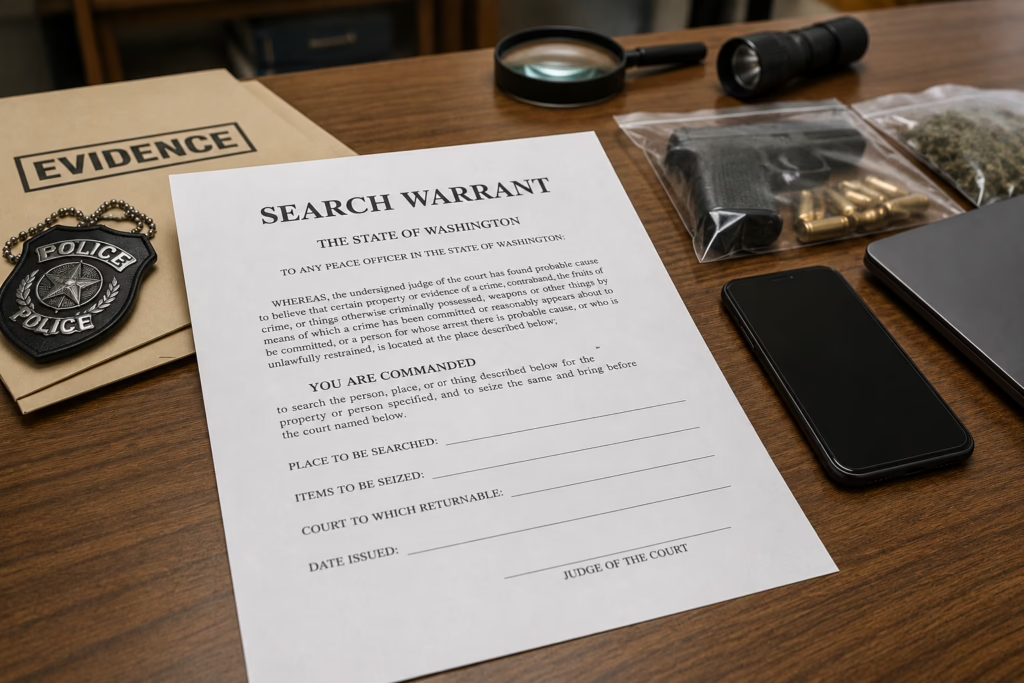
Washington CrR 2.3 governs the issuance, execution, and return of search warrants in Washington criminal cases. It outlines:
- Who may request a search warrant.
- What property or persons may be searched or seized.
- The probable cause required before a warrant may issue.
- How search warrants must be executed.
- Procedures for returning seized property.
- How illegally seized property may be challenged.
- Special rules governing searches involving members of the news media.
The rule works alongside both the Fourth Amendment to the United States Constitution and Article I, Section 7 of the Washington Constitution, which often provides even greater privacy protections than federal law.
Who Can Request a Search Warrant?
Under CrR 2.3(a), a search warrant may be requested by:
- A peace officer; or
- A prosecuting attorney.
A judge—not law enforcement—must determine whether probable cause exists before issuing the warrant.
What Can Be Seized Under a Search Warrant?
CrR 2.3(b) authorizes search warrants for several categories of property and persons.
Evidence of a Crime
Police may seek a warrant to seize evidence connected to a criminal investigation, including documents, electronic devices, financial records, DNA evidence, photographs, or other items relevant to proving an offense.
Contraband or Fruits of Crime
Search warrants may also authorize the seizure of:
- Illegal drugs;
- Stolen property;
- Counterfeit items;
- Unlawfully possessed firearms; or
- Property obtained through criminal activity.
Weapons or Instrumentalities of Crime
Law enforcement may seize weapons or other objects used to commit—or reasonably believed to be about to facilitate—a crime.
Persons
A search warrant may also authorize officers to locate and seize a person:
- For whom probable cause exists to support an arrest; or
- Who is being unlawfully restrained, such as a kidnapping victim.
Probable Cause Is Required Before Any Search Warrant
Judicial Review
A search warrant cannot be issued simply because law enforcement requests one.
Instead, the court must independently determine that probable cause exists.
Probable cause generally means there are sufficient facts to lead a reasonable person to believe that evidence of a crime will likely be found in the place to be searched.
What Evidence May Be Considered?
The judge may consider:
- Sworn affidavits;
- Declarations authorized under General Rule (GR) 13;
- Sworn testimony presented in person or through reliable electronic means.
The testimony must be recorded and preserved as part of the court record. If the validity of the warrant is later challenged, the testimony may be transcribed for review.
Like many probable cause determinations, the judge may consider hearsay evidence, provided constitutional requirements are satisfied.
What Must a Search Warrant Include?
A valid search warrant must:
- Identify the property or person to be seized.
- Describe the place to be searched with sufficient particularity.
- Be directed to a peace officer.
- Be executed within a specified time not exceeding 10 days after issuance.
- Identify the court where the warrant will be returned.
These requirements help prevent overly broad or “general” searches, which are prohibited under both the federal and Washington constitutions.
How Must a Search Warrant Be Executed?
Providing a Copy of the Warrant
When officers seize property, they generally must provide:
- A copy of the search warrant; and
- A receipt describing the property taken.
If no one is present during the search, officers may leave or post the warrant and receipt at the location.
Inventory of Seized Property
CrR 2.3 also requires officers to prepare a written inventory of all seized property.
Whenever possible, the inventory must be completed in the presence of:
- The person from whom the property was taken; or
- At least one other witness besides the executing officer.
Upon request, the court must provide a copy of the inventory to both the property owner and the applicant for the warrant.
What If Police Conduct an Illegal Search?
Motion for Return of Property
CrR 2.3(e) allows a person whose property was unlawfully seized to ask the court to return it.
The court may order the property returned if:
- The search violated constitutional protections;
- The warrant was invalid; or
- The government unlawfully retained property.
Motion to Suppress Evidence
If criminal charges have already been filed, a motion seeking the return of property is generally treated as a motion to suppress evidence.
Suppression can have a significant impact on a criminal case. If key evidence is excluded because it was obtained unlawfully, prosecutors may have difficulty proving the charges beyond a reasonable doubt.
Special Rules for Searches of the News Media
Protecting Journalistic Materials
CrR 2.3(f) recognizes additional legal protections for members of the news media.
When a search involves materials protected under RCW 10.79.015 or the federal Privacy Protection Act (42 U.S.C. §§ 2000aa et seq.), courts generally must issue a subpoena duces tecum rather than a search warrant.
A subpoena allows the media organization to produce the requested materials voluntarily instead of having officers seize them.
Only in limited circumstances authorized by state and federal law may a court issue a search warrant for protected journalistic materials.
These provisions help safeguard freedom of the press while still allowing legitimate criminal investigations to proceed.
Why Washington CrR 2.3 Matters
Search warrants often determine the outcome of a criminal case. Evidence obtained during a search may include drugs, firearms, financial records, cell phones, computers, or other items that prosecutors rely on to prove guilt.
Because Washington’s Constitution provides particularly strong privacy protections, courts carefully scrutinize whether officers complied with CrR 2.3, the Fourth Amendment, and Article I, Section 7.
If officers obtained evidence through an unlawful search or executed a warrant improperly, that evidence may be excluded from trial. In some cases, suppression of illegally obtained evidence can substantially weaken—or even result in the dismissal of—the prosecution’s case.
For anyone facing criminal charges involving a search warrant, early review by an experienced criminal defense attorney is essential.
Contact Blanford Law
If law enforcement searched your home, vehicle, phone, or other property, it is important to determine whether the search complied with Washington CrR 2.3 and constitutional requirements. An experienced criminal defense attorney can evaluate the validity of the warrant, challenge unlawful searches, and seek suppression of illegally obtained evidence.
Contact Blanford Law today at ken@blanfordlaw.com or 253-720-9304 for guidance on your legal matter.
Additional Resources
Search Incident to Arrest in Washington
Learn when law enforcement may search a person or vehicle without a warrant following an arrest and how Washington’s Constitution provides greater privacy protections than federal law.
https://blanfordlaw.com/search-incident-to-arrest-wa/
Washington’s Cell Site Simulator Law
Discover how Washington regulates the use of cell site simulators (commonly known as “Stingrays”) and the warrant requirements that protect electronic privacy during criminal investigations.
https://blanfordlaw.com/washington-cell-site-simulator-law/
Bench Warrants in Washington: What You Need to Know
Find out why courts issue bench warrants, the consequences of an outstanding warrant, and the steps you can take to resolve one.
https://blanfordlaw.com/bench-warrant-washington/
State v. Collins: Reckless Driving in Washington
Read about the State v. Collins decision and how Washington courts interpret reckless driving offenses and the evidence required to support a conviction.
https://blanfordlaw.com/state-v-collins-reckless-driving/