
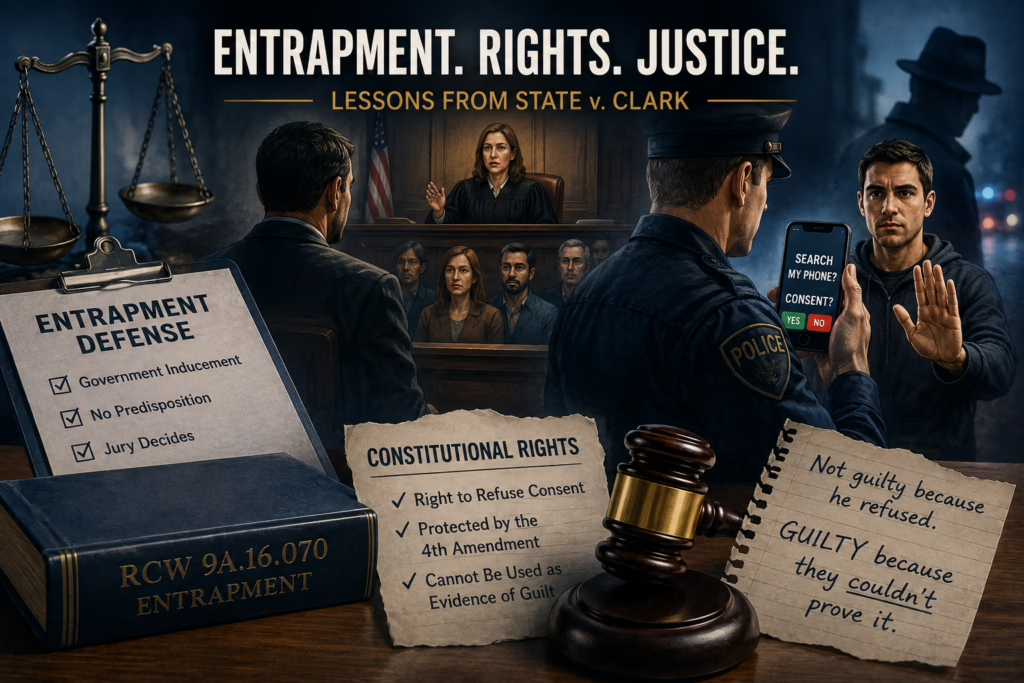
A Washington entrapment defense can arise when law enforcement induces a person to commit a crime the person was not otherwise predisposed to commit. A recent Washington Court of Appeals decision, State v. Clark, No. 59689-0-II, highlights not only when a defendant may be entitled to have a jury consider entrapment, but also an important constitutional principle: exercising the right to refuse consent to a warrantless search should not be transformed into evidence of guilt.
Division Two reversed Clark’s convictions and ordered a new trial. The court concluded that Clark had presented sufficient evidence to warrant an entrapment instruction and that prosecutors improperly used his refusal to consent to a warrantless search of his cell phone as evidence against him.
There is an important limitation on the decision, however: State v. Clark is an unpublished opinion. It does not establish binding Washington precedent. The opinion is nevertheless useful for understanding how established constitutional and Washington-law principles can operate in an actual criminal prosecution.
What Happened in State v. Clark?
Clark’s prosecution arose from an undercover law-enforcement operation. His defense centered in part on his interactions with law enforcement and whether government conduct induced the criminal activity underlying the charges.
At trial, Clark sought an entrapment jury instruction. That instruction would have allowed jurors to decide whether the government’s conduct satisfied Washington’s requirements for an entrapment defense.
The trial court refused to give the instruction.
A separate constitutional issue arose from Clark’s cell phone. Clark refused to consent to a warrantless search of the device. The prosecution subsequently used that refusal as evidence supporting its case against him.
On appeal, Division Two concluded that both issues required reversal.
The court held that Clark had produced enough evidence to put entrapment before the jury. It also determined that the State improperly used Clark’s exercise of his constitutional right to refuse a warrantless phone search as evidence of guilt.
The result was significant: Clark received a new trial.
Washington Entrapment Defense Under RCW 9A.16.070
Washington has codified entrapment in RCW 9A.16.070.
The statute provides that entrapment is established when:
- The criminal design originated in the mind of law enforcement officials or a person acting under their direction;
- Law enforcement lured or induced the defendant to commit a crime the defendant had not otherwise intended to commit; and
- The defendant’s criminal conduct was the direct result of the government’s inducement.
The statute also makes an important distinction:
Merely providing someone with an opportunity to commit a crime does not constitute entrapment.
That distinction is central to understanding a Washington entrapment defense.
Opportunity Is Not the Same as Entrapment
Police are generally permitted to conduct undercover operations and provide opportunities for people to commit crimes.
The mere fact that an undercover officer asks about buying drugs, poses as a potential customer, or otherwise creates an opportunity for criminal activity does not automatically establish entrapment.
Entrapment focuses on something more.
The issue becomes whether government conduct went beyond providing an opportunity and instead induced an otherwise unwilling person to commit the offense.
That can make the defendant’s predisposition particularly important.
What Does Predisposition Mean?
Predisposition generally concerns whether the defendant was already willing or inclined to commit the crime before the government’s allegedly improper inducement.
A person who readily accepts an ordinary opportunity to commit a crime is in a different position from someone who initially refuses but eventually participates after substantial government pressure or inducement.
The distinction can be highly fact-dependent.
That is precisely why the availability of a jury instruction can matter so much.
When Is a Defendant Entitled to an Entrapment Instruction?
A criminal defendant does not have to prove the entire entrapment defense to the judge before the jury may consider it.
Instead, the question at the instruction stage is whether sufficient evidence exists to support giving the instruction.
This distinction was critical in Clark.
Division Two concluded that Clark had presented enough evidence from which a jury could find entrapment. Consequently, it was for the jury—not the trial judge—to decide whether the defense ultimately succeeded.
That does not mean the Court of Appeals decided Clark was entrapped.
It means Clark was entitled to have jurors consider the defense.
Why Jury Instructions Matter
Jury instructions tell jurors which legal rules they must apply when deciding a case.
If evidence supports a recognized defense but the jury never receives the corresponding instruction, jurors may have no legal framework for evaluating that defense.
For someone asserting a Washington entrapment defense, the distinction can be decisive.
A defendant can present testimony and evidence suggesting improper government inducement, but without an entrapment instruction, the jury is not instructed to decide the case under the statutory requirements of RCW 9A.16.070.
In Clark, Division Two determined that refusing the instruction was error.
Clark’s Refusal to Allow a Cell-Phone Search Created a Second Issue
The case involved another issue that has implications far beyond entrapment.
Clark refused to consent to a warrantless search of his cell phone.
The prosecution then used that refusal as evidence against him.
Division Two concluded that this was improper.
The principle behind that conclusion is important: a person generally should not be penalized for asserting a constitutional right.
Can You Refuse a Warrantless Cell-Phone Search in Washington?
Cell phones receive significant constitutional protection.
The Fourth Amendment to the United States Constitution protects against unreasonable searches and seizures. Article I, section 7 of the Washington Constitution provides its own strong protection for private affairs.
Modern phones can contain enormous amounts of personal information: communications, photographs, location information, browsing activity, financial information, contacts, documents, and other sensitive data.
The United States Supreme Court addressed the privacy interests associated with cell phones in Riley v. California, 573 U.S. 373 (2014), holding that police generally must obtain a warrant before searching digital information on a cell phone seized incident to arrest.
There are exceptions to warrant requirements, and the legality of any particular search depends on the circumstances. Consent is one potential basis for a warrantless search.
But consent means the person agrees to the search.
If officers ask for permission to search a phone, the person can decline to provide that consent.
Refusing Consent Is Not the Same as Admitting Guilt
This is the second major lesson from Clark.
A person’s refusal to consent to a warrantless search should not automatically be treated as suspicious conduct demonstrating guilt.
Consider the problem created by the opposite rule.
If refusing consent could be used to establish guilt, a constitutional choice would become a trap:
Consent to the search, or refuse and have the refusal used against you.
That would burden the exercise of the constitutional protection itself.
Division Two concluded that prosecutors improperly used Clark’s refusal to consent to the phone search as evidence against him.
Refusing Consent Does Not Necessarily Prevent a Search
There is an equally important practical distinction.
Refusing consent does not necessarily mean police cannot search the phone.
Law enforcement may seek a search warrant. If a judge determines that the applicable legal requirements are satisfied, a warrant may authorize the search despite the owner’s refusal.
Other recognized exceptions to the warrant requirement can also arise depending on the circumstances.
Refusing consent means the person is not voluntarily supplying consent as the legal justification for the search. It does not provide immunity from a search that is otherwise legally authorized.
Why Cell Phones Receive Special Constitutional Attention
The constitutional significance of cell-phone searches reflects how much personal information modern devices contain.
A phone is not simply the digital equivalent of a wallet or a few pieces of paper.
In Riley, the United States Supreme Court recognized the extraordinary quantity and nature of information stored on modern cell phones when analyzing the Fourth Amendment warrant requirement.
Washington’s constitution may provide additional protection through article I, section 7, which states:
“No person shall be disturbed in his private affairs, or his home invaded, without authority of law.”
For criminal defendants, this makes the legal basis for a phone search an important issue to examine.
Questions can include whether officers had a warrant, what the warrant authorized, whether consent was actually voluntary, and whether the search exceeded the lawful scope of the authority supporting it.
Prosecutors Cannot Improperly Penalize the Exercise of Constitutional Rights
Clark illustrates a broader principle in criminal cases.
The State’s evidence and argument cannot improperly invite a jury to infer guilt merely because a defendant exercised a constitutional protection.
That concept can arise in different contexts.
The precise analysis depends on the constitutional right involved and how the prosecution used the defendant’s conduct. But Clark demonstrates why defense counsel should scrutinize arguments suggesting that asserting a constitutional protection itself demonstrates consciousness of guilt.
Here, that issue concerned refusing consent to a warrantless search of a cell phone.
The Court of Appeals concluded that the prosecution crossed the line.
Why Division Two Ordered a New Trial
The appellate court did not merely identify technical errors and leave Clark’s convictions intact.
It reversed and ordered a new trial.
Two important issues drove the decision:
First, Clark presented sufficient evidence to support an entrapment instruction. The jury therefore should have been permitted to evaluate his defense under the appropriate legal standard.
Second, the prosecution improperly used his refusal to consent to a warrantless cell-phone search as evidence against him.
The new-trial remedy is significant because it demonstrates how jury-instruction errors and constitutional errors can affect the fairness of the trial itself.
A reversal, however, is not equivalent to an acquittal.
Ordering a new trial generally means the prior judgment cannot stand and the case returns for further proceedings consistent with the appellate decision.
State v. Clark Is an Unpublished Opinion
There is an especially important qualification when discussing State v. Clark: the opinion is unpublished.
That means it does not carry the same precedential authority as a published Washington Court of Appeals opinion.
Washington GR 14.1 governs citation to unpublished opinions.
Qualifying unpublished Washington Court of Appeals opinions filed on or after March 1, 2013, may be cited as nonbinding authority subject to the requirements of GR 14.1.
Clark Does Not Create Binding Washington Law
This distinction is important for both lawyers and members of the public reading about appellate decisions.
It would be inaccurate to say:
“State v. Clark establishes that Washington courts must…”
Instead, Clark should be understood as an example of how one Washington Court of Appeals panel applied existing law to the facts before it.
The opinion can be informative and potentially persuasive where citation is permitted, but it does not have precedential value.
The underlying constitutional and statutory principles should therefore be grounded in binding authorities, including the Washington entrapment statute, constitutional search-and-seizure protections, and applicable published appellate decisions.
What Clark Teaches About a Washington Entrapment Defense
Despite its unpublished status, Clark provides several useful lessons.
First, entrapment is not established simply because an undercover officer participated in an investigation. Washington law distinguishes between providing an opportunity and inducing someone to commit a crime the person did not otherwise intend to commit.
Second, when the evidence is sufficient to support an entrapment defense, the defendant may be entitled to have the jurydecide it. The trial court should not effectively decide the factual merits of a supported defense by refusing the necessary instruction.
Third, constitutional rights matter during an investigation as well as at trial. A defendant’s decision not to consent to a warrantless search should not simply be converted into evidence that the defendant must have something to hide.
Finally, appellate review can examine not only whether the evidence supported a conviction but whether the defendant received a trial conducted under the correct legal rules.
What Should You Do If Police Ask to Search Your Cell Phone?
Every criminal investigation is different, and specific legal advice depends on the circumstances.
As a general matter, however, it is important to distinguish between consenting to a search and law enforcement conducting a search under independent legal authority.
If officers have a valid warrant, refusing consent does not necessarily stop the authorized search.
If officers are asking for consent, the request itself may raise questions about what authority currently exists to conduct the search.
A person facing a criminal investigation should avoid physically interfering with law enforcement. Questions concerning the legality of a search can be addressed through the legal process.
If a phone has already been searched, an attorney can examine the asserted legal basis for that search and whether constitutional requirements were satisfied.
Speak With a Washington Criminal Defense Attorney
Entrapment, undercover investigations, search warrants, cell-phone searches, and prosecutorial use of constitutional rights can raise complicated factual and legal questions.
As State v. Clark illustrates, those issues can affect not only what evidence the State may present but also which defenses the jury must be allowed to consider.
Contact Blanford Law today at ken@blanfordlaw.com or 253-720-9304 for guidance on your legal matter.
Additional Resources
State v. Marcum: Washington Criminal Case
Learn how State v. Marcum addresses important Washington criminal-law issues and the constitutional protections that can affect a prosecution.
Washington Cell-Site Simulator Law
Explore Washington law governing law enforcement’s use of cell-site simulators and the privacy and search-and-seizure concerns raised by digital surveillance.
Washington CrR 2.3: Search Warrants
Review Washington CrR 2.3 and the procedures governing search warrants, including the legal authority police may rely on when seeking evidence during a criminal investigation.
Search Incident to Arrest in Washington
Learn about the search-incident-to-arrest exception to the warrant requirement and the limits Washington law places on searches conducted after an arrest.
Washington Jury Instruction Error Case
Learn why proper jury instructions matter in Washington criminal trials and how an instructional error can become an important issue on appeal.