
If you have prior convictions from another state or from federal court, those convictions may affect your sentence if you are convicted of a crime in Washington. However, they do not automatically count toward your offender score.
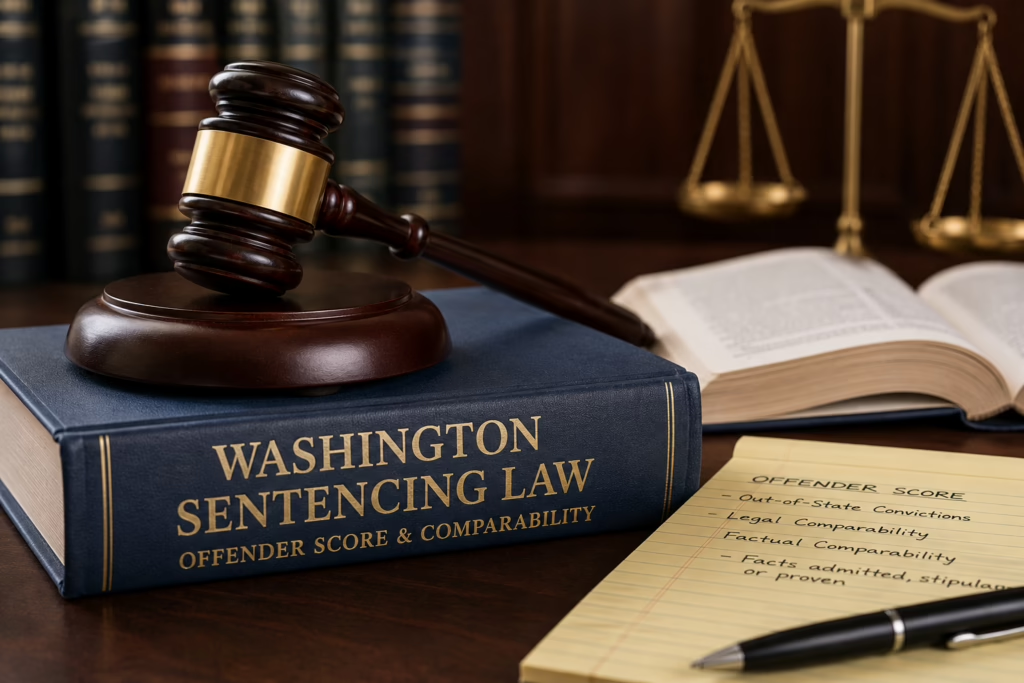
Washington courts must determine whether an out-of-state conviction is comparable to a Washington offense before including it in the offender score. This process is known as Washington offender score comparability, and it can significantly impact the length of a sentence.
A recent Court of Appeals decision involving Bruce Gingrich illustrates why this issue matters.
What Is an Offender Score?
Under Washington’s Sentencing Reform Act, a defendant’s offender score helps determine the standard sentencing range.
Generally, the higher the offender score, the longer the potential prison sentence.
Prior convictions from Washington are usually straightforward to calculate. However, convictions from another state or from federal court require an additional legal analysis before they may be counted.
Washington Offender Score Comparability
Washington courts use a two-step process when evaluating an out-of-state conviction.
Legal Comparability
First, the court compares the elements of the foreign offense with the elements of a comparable Washington crime.
If the out-of-state statute is identical to—or narrower than—the Washington statute, the conviction generally counts toward the offender score.
Factual Comparability
If the foreign statute is broader than Washington law, the court must determine whether the defendant’s actual conduct would have violated Washington law.
Importantly, the court may rely only on facts that were:
- Admitted by the defendant;
- Stipulated by the defendant; or
- Proven beyond a reasonable doubt.
The court cannot speculate about what happened.
The Gingrich Decision
In In re Personal Restraint of Gingrich, the petitioner argued his attorney provided ineffective assistance by stipulating that a prior federal armed bank robbery conviction counted in his offender score without first reviewing the underlying records.
His attorney later acknowledged that no comparability analysis had been completed before agreeing to include the conviction.
The Court of Appeals assumed, without deciding, that counsel’s performance may have been deficient. However, the court denied relief because Gingrich could not establish prejudice.
After reviewing the federal plea documents submitted during the personal restraint petition, the court concluded that Gingrich admitted facts showing conduct that would have constituted first-degree robbery under Washington law. Because the conviction would ultimately have counted after a proper factual comparability analysis, there was no reasonable probability that the sentencing outcome would have been different.
Accordingly, the court denied the petition.
Why This Decision Matters
The case serves as a reminder that sentencing can be just as important as the trial itself.
Defense attorneys should carefully review:
- Certified judgments
- Charging documents
- Plea agreements
- Findings of fact
- Jury verdicts
- Comparable Washington statutes
before agreeing that an out-of-state conviction counts toward an offender score.
Likewise, prosecutors bear the burden of proving that an out-of-state conviction is comparable under Washington law.
When either side overlooks the comparability analysis, sentencing errors can occur.
Ineffective Assistance of Counsel Claims
Not every attorney mistake results in relief.
To establish ineffective assistance of counsel, a defendant generally must prove both:
- Counsel performed deficiently; and
- The deficient performance prejudiced the outcome.
The Court of Appeals held that Gingrich failed on the second requirement. Even if counsel should have demanded a comparability hearing, the federal plea documents established that the conviction was factually comparable to Washington first-degree robbery.
Because the sentencing court would have reached the same result, there was no prejudice.
This Opinion Is Unpublished and Should Not Be Cited
It is important to understand that In re Personal Restraint of Gingrich, No. 60344-6-II (Wash. Ct. App. July 15, 2025), is an unpublished opinion.
Under GR 14.1, unpublished opinions of the Washington Court of Appeals are not binding precedent. While unpublished decisions may sometimes be cited as nonbinding persuasive authority under limited circumstances, they should not be relied upon as controlling law and do not have the same precedential value as published opinions.
The legal principles discussed in Gingrich—including offender score comparability and ineffective assistance of counsel—are based on established Washington statutes and published appellate decisions. Those published authorities, rather than the unpublished opinion itself, remain the primary sources of Washington law.
For that reason, Gingrich is best understood as an illustration of how Washington courts apply existing law to a particular set of facts, rather than as a case establishing new legal rules.
Conclusion
Out-of-state convictions can have a substantial impact on a defendant’s offender score, but they do not automatically count. Washington courts must conduct a careful legal and factual comparability analysis before including those convictions in a sentence.
If questions arise about whether a prior conviction should be included, both the prosecution and defense should ensure the necessary records are reviewed and the proper legal analysis is completed.
Call to Action
Contact Blanford Law today at ken@blanfordlaw.com or 253-720-9304 for guidance on your legal matter.
Additional Resources
If you would like to learn more about Washington sentencing, offender scores, and related criminal law topics, these resources may be helpful:
- Understanding Your Washington Offender Score (WYSGOLL)Learn how Washington calculates an offender score, why it matters at sentencing, and how prior convictions can affect the standard sentencing range.
- How Is an Offender Score Calculated in Washington?Explore the factors that influence an offender score, including prior convictions, juvenile adjudications, and sentencing enhancements.
- How Do I Find Someone in the SCORE Jail?Find information about locating an inmate at the SCORE Jail, visiting procedures, and other frequently asked questions for families and friends.
- Out-of-State Bail Bond Agents in WashingtonLearn how out-of-state bail bonds work in Washington and what to expect if a defendant is arrested while traveling or living outside the state.
- Washington Blake Resentencing AppealsUnderstand how the Washington Supreme Court’s Blake decision has affected criminal sentences and when resentencing or appeals may be available.