
In State v. Zerahaimanot, the Washington Court of Appeals (Division I) resolved key questions about resentencing, waiver of appellate arguments, and the limits on citing unpublished opinions. Because this case was filed as an unpublished opinion, it must be understood in the context of Washington’s rules governing citation of such decisions — particularly General Rule 14.1 (GR 14.1). Washington Courts
This article explains the import of Zerahaimanot, the Rule limiting citation to unpublished opinions, and how appellate claims can be waived under the Washington Rules of Appellate Procedure (RAP). It also provides direct links to the statutes and rules cited.
Background of State v. Zerahaimanot
In State v. Zerahaimanot, the defendant’s prior murder conviction was modified on direct appeal almost a decade earlier. On resentencing following another appellate development (State v. Blake, discussed below), the defendant challenged several sentencing issues that he had not raised in the trial court. The Court of Appeals held that those claims were waived because he failed to present them for the trial court’s consideration. (Opinion dated Nov. 26, 2025).
Most significantly, the opinion is unpublished, which affects how — or whether — it can be cited.
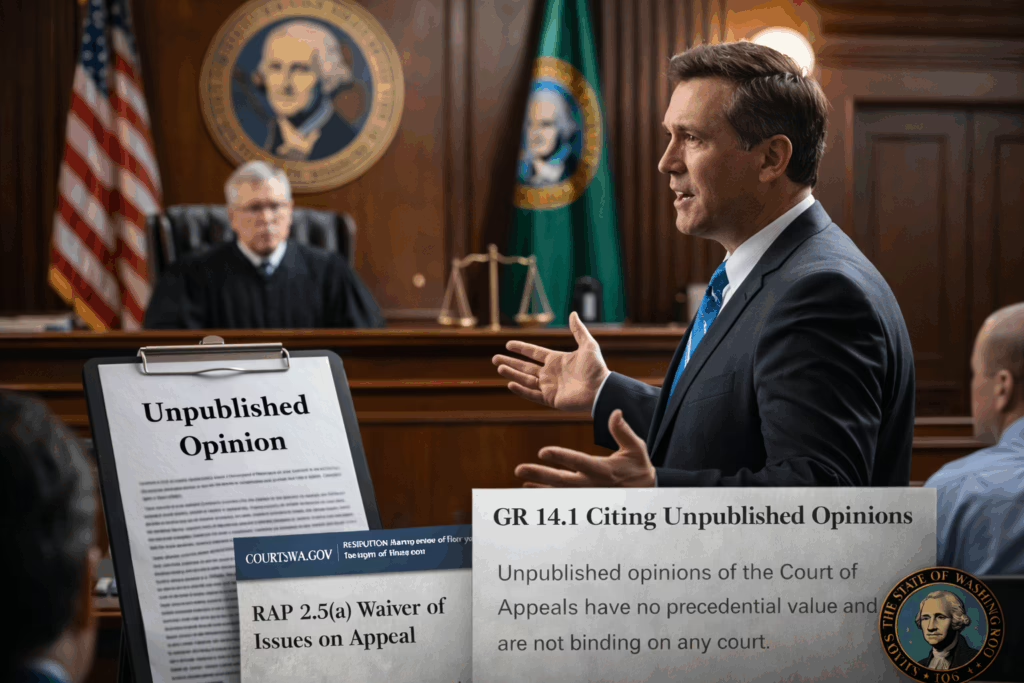
Unpublished Opinions and GR 14.1
Under Washington law, opinions designated unpublished have specific restrictions on citation:
- General Rule 14.1 (GR 14.1) governs citation of unpublished opinions.
- Under GR 14.1(a), unpublished opinions of the Court of Appeals have no precedential value and are not binding on any court.
- Opinions filed on or after March 1, 2013 may be cited as non‑binding authority, but only if identified as such.
- Washington appellate courts generally should not cite unpublished opinions in their own decisions unless necessary. Washington Courts
📌 You can read the full text of GR 14.1 here:
👉 https://www.courts.wa.gov/court_rules/pdf/GR/GA_GR_14_01_00.pdf Washington Courts
These rules implement RCW 2.06.040, which directs that only opinions with sufficient precedential value are published, reinforcing that unpublished opinions lack precedential effect. Washington Courts
Waiver of Issues on Appeal — RAP 2.5
Washington’s appellate process has strict rules about when a party forfeits issues by failing to raise them at the trial level:
- RAP 2.5(a) generally bars consideration of claims on appeal that were not raised in the trial court, unless the issue is a manifest error affecting a constitutional right.
- In Zerahaimanot, the defendant attempted to raise sentencing arguments for the first time on appeal. Applying RAP 2.5(a), the Court of Appeals held those claims were waived because he did not present them for trial court ruling. Washington Courts
📌 You can view the full text of the Washington Rules of Appellate Procedure here:
👉 https://www.courts.wa.gov/court_rules/?fa=court_rules.rulesPDF&groupName=RAP Washington Courts
Resentencing and State v. Blake
The backdrop for the resentencing in Zerahaimanot was the Washington Supreme Court’s landmark decision in State v. Blake, 197 Wash.2d 170, 481 P.3d 521 (2021). In Blake, the Supreme Court held that RCW 69.50.4013, Washington’s strict liability drug possession statute, violated due process because it allowed felony punishment without requiring proof of mens rea. Justia Law
📌 Decision text for Blake:
👉 https://law.justia.com/cases/washington/supreme-court/2021/96873-0.html Justia Law
The Blake ruling voided convictions under RCW 69.50.4013, making many offenders eligible for resentencing and correction of their offender score. Washington Corrections
What State v. Zerahaimanot Means in Practice
1️⃣ Unpublished Opinions Have Limited Force
Because Zerahaimanot is unpublished, its value is as persuasive authority only if cited responsibly under GR 14.1. It has no binding precedential value like a published opinion does. Washington Courts
2️⃣ Preservation of Error Is Critical
Under RAP 2.5(a), appellate arguments must be preserved by timely objection or motion at the trial level if a party hopes to raise them on appeal. Washington Courts
3️⃣ Blake Can Trigger Resentencing
Where convictions are affected by Blake, courts may revisit sentences to correct offender scores and adjust sentencing consequences. Washington Corrections
Call to Action
If you are facing a criminal appeal, resentencing issue, or questions about how unpublished opinions or waiver rules affect your case, contact Blanford Law for tailored legal guidance.
📧 ken@blanfordlaw.com
📞 253‑720‑9304
Additional Resources
- Why Unpublished Opinions Cannot Be Cited in Washington State Courts
Explains Washington’s rules against citing unpublished appellate decisions and how GR 14.1 restricts their use in legal arguments.
https://blanfordlaw.com/why-unpublished-opinions-cannot-be-cited-in-washington-state-courts/ - Washington Appeals Court: State v. Drake – Resentencing, Offender Score & Blake Ruling
Analyzes State v. Drake, a resentencing case influenced by the Blake decision, focusing on offender score corrections and procedural safeguards.
https://blanfordlaw.com/washington-appeals-court-state-v-drake-resentencing-offender-score-blake-ruling/ - RCW 2.06.040 – Court Decisions
Discusses the Washington statute governing publication of Court of Appeals decisions and how it defines which cases are precedential.
https://blanfordlaw.com/rcw-2-06-040-court-decisions/ - Understanding ER 703 – Bases of Opinion Testimony by Experts in Washington State
Explores how expert witnesses may rely on otherwise inadmissible facts when forming their opinions under Washington’s ER 703.
https://blanfordlaw.com/understanding-er-703-bases-of-opinion-testimony-by-experts-in-washington-state/ - Understanding ER 704 – Opinion on Ultimate Issue in Washington State
Breaks down the Washington rule allowing expert opinions on ultimate issues — and where courts draw the line under ER 704.
https://blanfordlaw.com/understanding-er-704-opinion-on-ultimate-issue-in-washington-state/