
Washington Bail Bond Equitable Relief in Unpublished Opinion
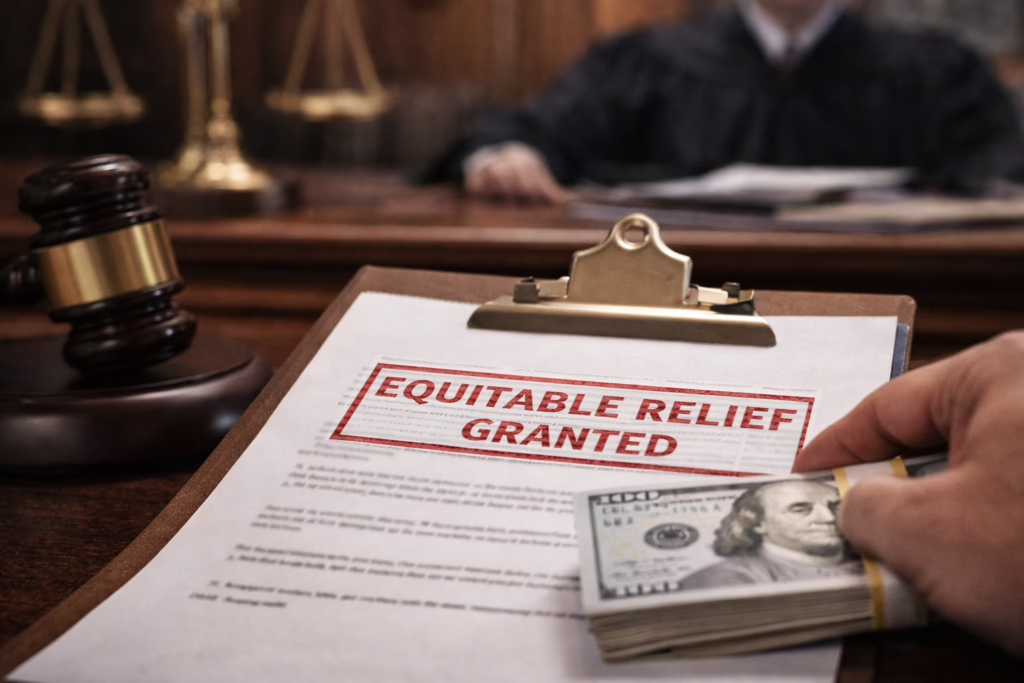
A recent Washington Court of Appeals decision highlights when bail bond companies may recover forfeited funds—even when statutory requirements are not strictly satisfied. In State v. Strong, the court ruled that a bail bond company was entitled to equitable relief and return of its bond.
In this case, Ace’s Bail Bonds posted a $5,000 bond for a defendant who later failed to appear. The trial court initially denied the company’s request to return the bond. However, the Court of Appeals reversed, finding that equity required the bond to be returned.
This case is critical for bail bond companies because it clarifies how equitable relief can override strict statutory limitations in Washington.
How Bail Bond Forfeiture Works in Washington
Statutory Grounds for Relief
Washington law provides two primary statutory paths to recover a forfeited bond:
- 60-Day Rule (RCW 10.19.105):
If the defendant is returned within 60 days, the bond is automatically exonerated. - 12-Month Rule (RCW 10.19.140):
After 60 days, the bond may still be returned if the surety is directly responsible for producing the defendant.
In Strong, the bail bond company did not meet either statutory requirement.
Washington Bail Bond Equitable Relief Explained
When Courts Can Grant Equitable Relief
Even when statutory relief is unavailable, Washington courts may grant equitable relief if:
- The purpose of the bond has been satisfied
- The defendant was not intentionally evading the court
- Justice and fairness support returning the bond
Courts are instructed to apply equitable relief liberally.
Key Factor: Defendant Incarcerated in Another State
In Strong, the defendant:
- Failed to appear in Washington
- Was incarcerated in Montana during the relevant time period
- Notified the court of her incarceration
The Court of Appeals emphasized that out-of-state incarceration strongly favors returning the bond.
This is because the defendant was not actively fleeing—she was already in custody and could have been returned through legal processes.
Why the Trial Court Got It Wrong
Failure to Apply Equitable Principles
The trial court focused only on whether the bail bond company:
- Took action to return the defendant
- Met statutory requirements
However, the appellate court held this was a legal error. The court failed to consider:
- The defendant’s incarceration
- The lack of intentional evasion
- The broader purpose of bail
Because of this, the denial of the bond return was an abuse of discretion.
Key Lessons for Bail Bond Companies
1. Statutory Compliance Is Not the Only Path
Even if you cannot meet:
- The 60-day return rule, or
- The 12-month “direct responsibility” requirement
You may still recover the bond through equitable relief.
2. Incarceration in Another Jurisdiction Matters
If a defendant is:
- In custody in another state
- Not intentionally avoiding court
Courts are far more likely to grant relief.
3. Proper Legal Arguments Are Critical
In Strong, the court noted that better briefing could have avoided the appeal entirely. Bail bond companies should:
- Clearly distinguish between statutory and equitable arguments
- Present all relevant evidence early
- Cite controlling case law
Unpublished Opinion Notice (Washington Law)
This case is an unpublished opinion. Under Washington law:
- Unpublished opinions are not binding precedent
- They may be cited as persuasive authority under GR 14.1
- Courts may consider them, but are not required to follow them
This makes State v. Strong a useful guide—but not controlling law.
Why This Case Matters
This decision reinforces a key principle:
Washington courts prioritize fairness over rigid statutory application in bail bond cases.
For bail bond companies, this means:
- There are additional avenues to recover forfeited funds
- Courts will consider the full factual context
- Legal strategy can significantly impact outcomes
Call to Action
If you own or operate a bail bond company and are facing bond forfeiture, experienced legal representation can make the difference.
Blanford Law can help you navigate Washington bail bond law and pursue recovery of forfeited funds. Contact Blanford Law today at ken@blanfordlaw.com or 253-720-9304 for guidance on your legal matter.
Additional Resources
- State v. Adams Bail Bond – Analysis of bail bond forfeiture and surety obligations in Washington.
https://blanfordlaw.com/state-v-adams-bail-bond/ - Does the Trial Court Have Discretion Regarding Bail Bond Forfeiture? – Learn how courts evaluate forfeiture decisions.
https://blanfordlaw.com/does-the-trial-court-have-discretion-regarding-the-forfeiture-of-bail-bonds/ - Understanding RCW 10.19.090 – Breakdown of the statute governing bail bond forfeiture.
https://blanfordlaw.com/understanding-rcw-10-19-090-forfeiture-and-exoneration-of-recognizance-in-washington-state/ - Navigating Bail Bond Forfeiture: State v. All City Bail Bonds – In-depth look at forfeiture and surety liability.
https://blanfordlaw.com/navigating-the-complexities-of-bail-bond-forfeiture-a-look-at-state-v-all-city-bail-bonds/ - Bail Bond Exoneration in Washington – Guidance on recovering forfeited bail bonds.
https://blanfordlaw.com/bail-bond-exoneration-washington/