
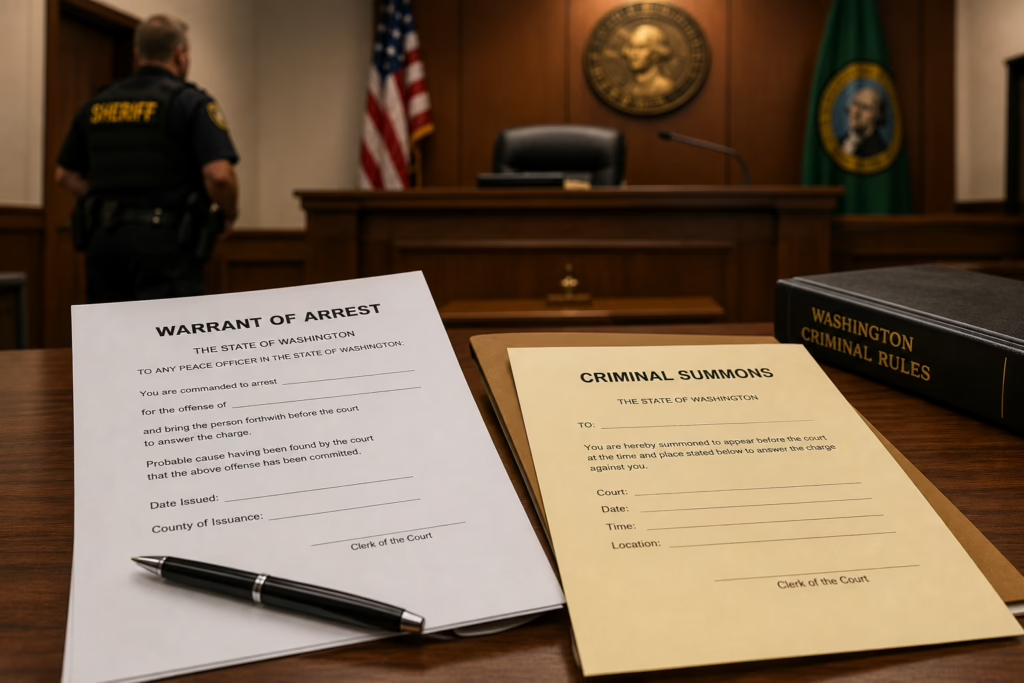
Being charged with a crime in Washington does not always mean law enforcement will immediately arrest you. In many cases, a court may issue a summons directing you to appear in court instead of an arrest warrant. Washington CrR 2.2 establishes the rules governing when courts may issue arrest warrants, when a summons is required, and the procedural safeguards that protect defendants before either document is issued.
Understanding Washington CrR 2.2 can help you know your rights and what to expect after criminal charges are filed.
What Is Washington CrR 2.2?
Washington CrR 2.2 governs the issuance of:
- Arrest warrants
- Criminal summons
- The execution and return of warrants
- Service of summons
- Amendment of defective warrants
- Dismissal of stale criminal charges
The rule balances the State’s interest in bringing defendants before the court with constitutional protections against unreasonable seizures.
When Can a Court Issue an Arrest Warrant?
After an indictment or information has been filed, the court may authorize the clerk to issue an arrest warrant.
However, a warrant is not automatic.
Probable Cause Is Required
Before issuing an arrest warrant, the judge must determine there is probable cause to believe the defendant committed the charged offense.
The court may rely upon:
- A sworn affidavit
- A declaration authorized under General Rule (GR) 13
- Sworn testimony presented under oath
The testimony must be recorded electronically, stenographically, or by another reliable method. The court may also consider hearsay evidence when making its probable cause determination, consistent with constitutional standards.
This requirement protects individuals from being arrested without sufficient legal justification.
The Court Must Attempt to Locate the Defendant First
One unique feature of Washington CrR 2.2 is that courts generally cannot issue an arrest warrant until reasonable efforts have been made to locate the defendant.
Required Database Searches
Before issuing most warrants, the court must determine that the complainant searched:
- The District Court Information System (DISCIS)
- Washington Department of Licensing records
- Department of Corrections offender database
The court may also require additional database searches if appropriate.
Exceptions to the Search Requirement
The address search is not required if:
- The defendant has already appeared in court;
- The defendant is already in custody; or
- The defendant’s identity is unknown.
Even if this procedure is overlooked, the warrant itself generally remains legally valid.
When Must the Court Issue a Summons Instead?
A Summons Is Often Preferred
Although courts may issue arrest warrants, CrR 2.2 generally favors issuing a summons whenever appropriate.
A summons directs the defendant to appear in court on a specified date without being arrested.
When a Summons Is Required
The court must issue a summons instead of a warrant unless it finds reasonable cause to believe the defendant:
- Will not appear voluntarily;
- Will commit a violent offense;
- Will interfere with witnesses;
- Will interfere with the administration of justice; or
- Is already in custody.
This reflects Washington’s preference for using the least restrictive method necessary to secure a defendant’s appearance.
What Happens If Someone Ignores a Summons?
If a defendant:
- Fails to appear after receiving a summons; or
- Cannot be successfully served,
the court may later issue an arrest warrant.
Ignoring a summons can therefore lead to more serious consequences than simply appearing as directed.
What Must an Arrest Warrant Include?
Required Contents
Under CrR 2.2(c), every warrant must contain:
- The name of the State of Washington
- The defendant’s name (or identifying description)
- The charged offense
- A finding that probable cause exists
- A command directing law enforcement to arrest the defendant
- Bail or release conditions, if the offense is bailable
These requirements ensure officers have clear legal authority to execute the warrant.
How Are Warrants and Summons Served?
Arrest Warrants
Arrest warrants may only be executed by Washington peace officers.
Criminal Summons
A summons may be served by:
- Personal delivery by a peace officer; or
- Mailing it to the defendant’s address.
Proper service is important because a defendant generally cannot be penalized for failing to appear if notice was not properly provided.
What If the Warrant Contains a Mistake?
Not every technical error invalidates criminal proceedings.
Defective Warrants Can Be Corrected
CrR 2.2 allows courts to amend warrants or summons to correct:
- Clerical mistakes;
- Errors in identifying the defendant;
- Technical defects in the charging information.
Similarly, if the court determines the defendant should face different charges, prosecutors may file a new information, and the court may issue a new warrant or summons rather than dismissing the case outright.
When Can Charges Be Dismissed for Failure to Issue a Warrant?
The 90-Day Rule
CrR 2.2(g) includes an important procedural safeguard.
A court must dismiss charges without prejudice if:
- Ninety days have passed since the information or indictment was filed;
- No arrest warrant has been issued; and
- The defendant has not appeared in court.
Before dismissal, the prosecutor must receive at least five days’ notice.
Because the dismissal is without prejudice, prosecutors may be able to refile the charges if permitted by law and the statute of limitations.
Why Washington CrR 2.2 Matters
Although CrR 2.2 focuses on procedure, it protects important constitutional rights by ensuring that arrests are supported by probable cause and that defendants are not unnecessarily taken into custody when a summons will suffice.
The rule also encourages efficient case management by requiring timely action after criminal charges are filed and providing a mechanism for dismissal when cases remain inactive for extended periods.
If you discover that an arrest warrant has been issued against you—or if you have received a criminal summons—it is important to speak with an experienced criminal defense attorney as soon as possible. Early legal representation may help resolve the matter before additional complications arise.
Contact Blanford Law
If you have been served with a criminal summons or learned that a warrant has been issued for your arrest, understanding your rights under Washington CrR 2.2 is critical. An experienced criminal defense attorney can evaluate the warrant, protect your constitutional rights, and help you navigate the criminal justice process.
Contact Blanford Law today at ken@blanfordlaw.com or 253-720-9304 for guidance on your legal matter.
Additional Resources
Bench Warrants in Washington: What You Need to Know
Learn what a bench warrant is, why courts issue them, and the steps you can take to address an outstanding warrant before it leads to an arrest.
https://blanfordlaw.com/bench-warrant-washington/
What to Do If You Miss Court in Pierce County Superior Court
Missing a court appearance can have serious consequences. This guide explains what happens next and the actions you should take to minimize the impact on your case.
https://blanfordlaw.com/18-what-to-do-when-you-miss-court-in-pierce-county-superior-court/
State v. Balles: Washington Court Decision Explained
Explore the Washington Court of Appeals’ decision in State v. Balles and how it affects criminal procedure and defendants’ rights in Washington courts.
https://blanfordlaw.com/balles-case-washington/
Washington’s Cell Site Simulator Law
Learn how Washington regulates law enforcement’s use of cell site simulators (often called “Stingrays”) and the privacy protections afforded under state law.
https://blanfordlaw.com/washington-cell-site-simulator-law/
State v. Collins: Reckless Driving in Washington
Read about State v. Collins and how the decision helps define reckless driving under Washington law and its implications for criminal prosecutions.
https://blanfordlaw.com/state-v-collins-reckless-driving/