
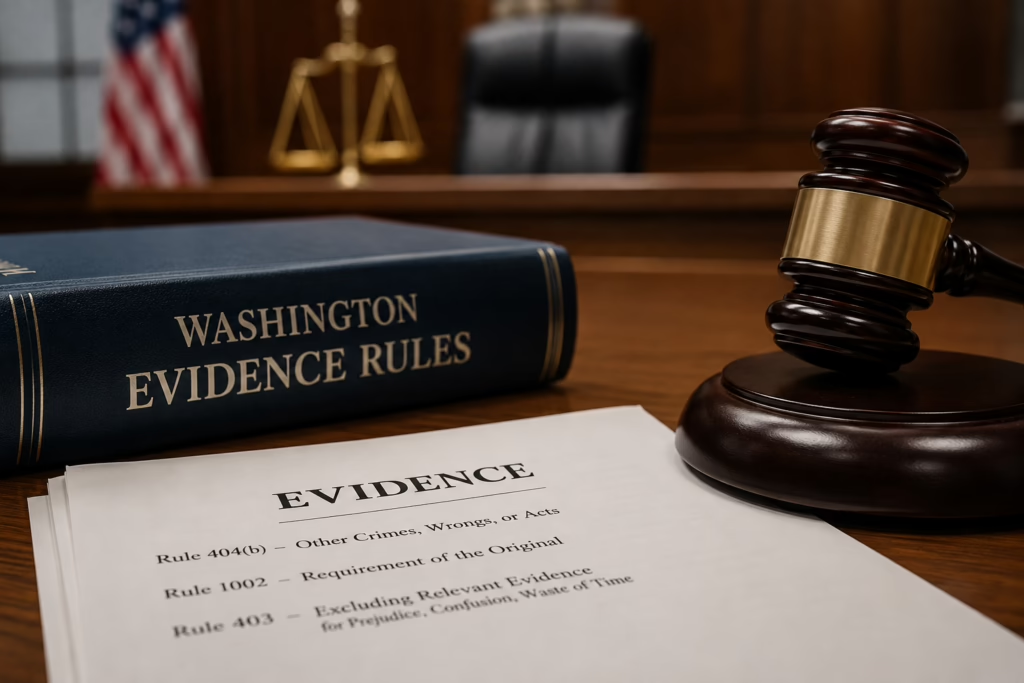
A recent Washington Court of Appeals decision demonstrates how evidentiary rulings can shape the outcome of a criminal trial. In State v. Gudgel, the court examined several important issues involving Washington evidence rules, including prior bad acts under ER 404(b), the best evidence rule under ER 1002, and mistrial standards.
The case provides a useful example of how Washington courts evaluate the admissibility of threatening communications, witness testimony, and contextual evidence in criminal prosecutions involving domestic violence allegations.
Why Evidence Rules Matter in Washington Criminal Cases
Evidence rules determine what juries are allowed to hear during trial. These rules are designed to balance fairness, reliability, and due process.
In Washington criminal cases, evidentiary disputes often become central appellate issues because improperly admitted evidence can unfairly prejudice a jury.
Common evidentiary disputes include:
- Prior misconduct allegations
- Text messages and voicemails
- Surveillance footage
- Police testimony
- Social media evidence
- Authentication challenges
- Hearsay objections
- Digital evidence disputes
In State v. Gudgel, the defendant challenged multiple evidentiary rulings after convictions for second-degree arson and felony violation of a court order.
ER 404(b): Prior Bad Acts Evidence
One of the most important evidence rules discussed in the case involved ER 404(b).
Under Washington law, ER 404(b) generally prohibits prosecutors from introducing evidence solely to show a defendant has a bad character or acted consistently with prior misconduct.
However, prior acts may still be admitted for other legitimate purposes, including:
- Motive
- Intent
- Identity
- Absence of mistake
- Common scheme or plan
- Context of the relationship
Threatening Voicemails and Relationship Evidence
In Gudgel, prosecutors introduced threatening and vulgar voicemails left for the alleged victim.
The defense argued the recordings were unfairly prejudicial and should have been excluded.
The Court of Appeals upheld the trial court’s decision to admit the evidence, concluding the messages helped establish the context of the relationship and explained the history between the parties.
Washington courts frequently allow relationship evidence in domestic violence prosecutions when the evidence helps jurors understand the dynamics between the individuals involved.
Still, courts must carefully weigh whether the probative value outweighs the danger of unfair prejudice.
ER 1002: The Best Evidence Rule
The appeal also addressed ER 1002, commonly referred to as the “best evidence rule.”
Under this rule, original writings, recordings, or photographs are generally required when a party seeks to prove the contents of that material.
The defense argued certain witness testimony should not have been admitted without the original evidence itself.
How Washington Courts Apply the Best Evidence Rule
Washington courts often analyze:
- Whether the contents of the document are actually at issue
- Whether duplicates are available
- Whether testimony is being used merely to describe events rather than prove precise contents
- Whether exceptions to the rule apply
The Court of Appeals rejected the defendant’s argument and found no reversible error.
This portion of the opinion highlights how appellate courts often defer to trial judges when evaluating evidentiary foundations and witness testimony.
Mistrial Standards and Trial Court Discretion
Another issue on appeal involved the denial of a motion for mistrial.
Washington trial judges have broad discretion when deciding whether alleged irregularities require a mistrial.
A mistrial is typically granted only when an event is so prejudicial that nothing short of a new trial can ensure fairness.
Appellate courts generally consider:
- The seriousness of the irregularity
- Whether the prejudice could be cured
- The strength of the remaining evidence
- Whether jury instructions addressed the issue
The appellate court concluded the defendant failed to show sufficient prejudice to justify overturning the convictions.
Domestic Violence Cases Often Involve Complex Evidence Issues
Domestic violence prosecutions frequently involve extensive evidentiary disputes.
Prosecutors often seek admission of:
- Prior threats
- No-contact order violations
- Voicemails
- Text messages
- Social media posts
- Witness statements
- Prior incidents involving the same parties
Defense attorneys may challenge whether the evidence is:
- Relevant
- Properly authenticated
- Unduly prejudicial
- Hearsay
- Cumulative
- Admissible under ER 404(b)
Because these rulings can substantially influence juries, evidentiary objections are often major appellate issues in Washington criminal cases.
Why Appellate Courts Rarely Reverse Evidence Rulings
One important takeaway from State v. Gudgel is that appellate courts generally give substantial deference to trial judges on evidentiary matters.
In Washington, appellate courts usually review evidence rulings for “abuse of discretion.” This is a difficult standard for defendants to overcome.
A reviewing court will often uphold a ruling unless it was manifestly unreasonable or based on untenable grounds.
As a result, many criminal appeals involving evidentiary challenges are unsuccessful unless the defendant can show both legal error and resulting prejudice.
Understanding Unpublished Opinions in Washington
It is important to understand that State v. Gudgel is an unpublished opinion from the Washington Court of Appeals.
Under Washington court rules, unpublished opinions generally are not binding precedent. Future courts are not required to follow unpublished decisions the same way they must follow published appellate opinions.
However, unpublished opinions can still provide valuable insight into:
- How Washington courts interpret evidence rules
- Common appellate arguments
- Trial court discretion
- Domestic violence prosecution strategies
- Criminal appeal trends
Attorneys frequently review unpublished opinions to better understand how appellate courts are analyzing similar legal and factual issues.
For readers interested in reviewing the court’s reasoning directly, the full unpublished opinion in State v. Gudgel is available through the Washington Courts website: https://www.courts.wa.gov/opinions/pdf/874292.pdf
Contact Blanford Law Today
If you are facing criminal charges involving complex evidentiary issues, domestic violence allegations, or appellate concerns, experienced legal representation is essential.
Contact Blanford Law today at ken@blanfordlaw.com or 253-720-9304 for guidance on your legal matter.
Additional Resources
Washington Statute of Repose Explained
Learn how Washington’s statute of repose laws can limit legal claims even before an injury or defect is discovered.
https://blanfordlaw.com/washington-statute-of-repose/
Traffic Infraction Payment Plans Under IRLJ 3.6
This article explains how drivers in Washington may request payment plans for traffic infractions under IRLJ 3.6.
https://blanfordlaw.com/traffic-infraction-payment-plan-irlj-3-6-washington/
RV Fire on I-90 Raises Legal and Safety Questions
Review the legal and liability issues that can arise after serious vehicle fires and roadway incidents in Washington State.
https://blanfordlaw.com/rv-fire-on-i90/
Washington Unpublished Opinion Rule
Learn how unpublished opinions work in Washington courts and when attorneys may still cite them.
https://blanfordlaw.com/washington-unpublished-opinion-rule/
Washington Unpublished Opinion: Keele
This article examines the unpublished Washington appellate decision in Keele and its legal significance.
https://blanfordlaw.com/washington-unpublished-opinion-keele/