
Washington Pen Register Law Explained
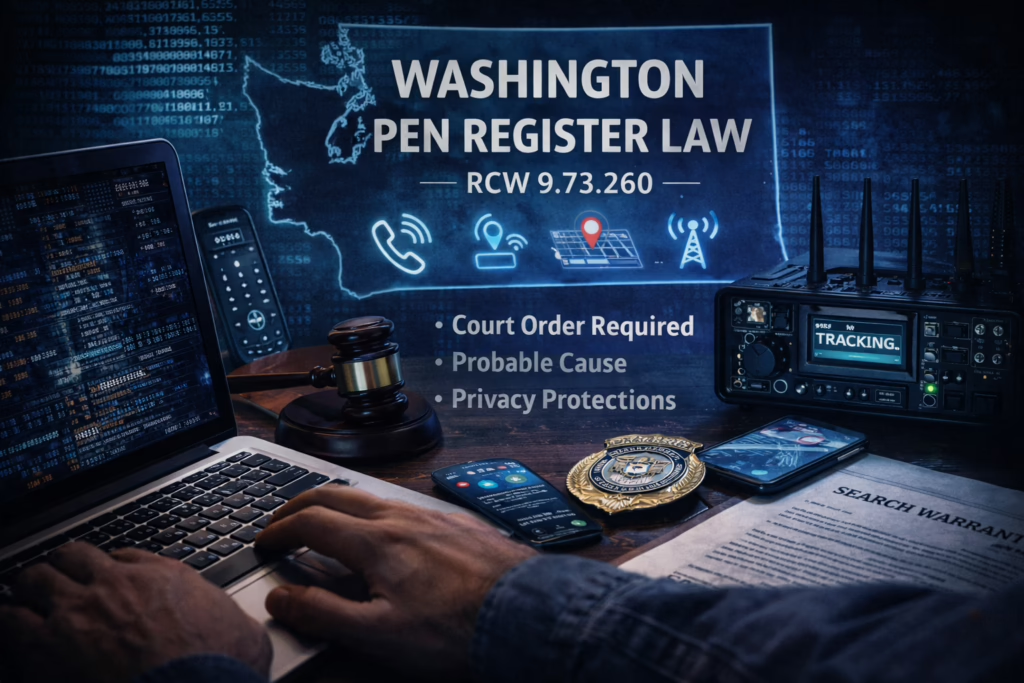
Washington law strictly regulates how law enforcement can use surveillance technology. Under RCW 9.73.260, the use of pen registers, trap and trace devices, and cell site simulator devices is limited and requires court approval in most situations.
You can read the full statute here:
https://app.leg.wa.gov/RCW/default.aspx?cite=9.73.260
The Washington pen register law is designed to balance law enforcement needs with strong privacy protections for individuals.
What Devices Are Covered Under RCW 9.73.260?
Pen Registers
A pen register records outgoing phone numbers dialed from a device. It does not capture the content of communications.
Trap and Trace Devices
A trap and trace device captures incoming numbers or identifying information from calls or communications.
Cell Site Simulator Devices
These devices (often called “Stingrays”) can:
- Track a phone’s location
- Force connections from nearby devices
- Collect metadata and identifying information
- Intercept communications signals
Because of their intrusive nature, these devices are heavily regulated under Washington law.
Court Order Requirement Under Washington Pen Register Law
General Rule: Court Approval Is Required
Law enforcement cannot install or use these devices without a prior court order, except in limited emergency situations.
To obtain a court order, officers must:
- Submit an application under oath
- Identify the law enforcement agency
- Certify the investigation is ongoing
Probable Cause Standard
The court must find:
- The information is relevant to an investigation
- There is probable cause to believe evidence of a crime will be obtained
If these requirements are met, the court may issue an order authorizing use of the device.
What Must Be Included in a Court Order?
A valid order must be highly specific. It may include:
- The target individual or device
- Phone numbers or account identifiers
- Geographic area of surveillance
- Type of data collected (including metadata)
- Potential collection of data from third parties
This level of detail ensures transparency and limits overbroad surveillance.
Time Limits and Extensions
60-Day Limit
Orders for surveillance devices generally last:
- Up to 60 days
Extensions Require Additional Proof
Extensions are not automatic. Law enforcement must:
- Submit a new application
- Show a higher likelihood of obtaining evidence
Further extensions require extraordinary circumstances, such as immediate danger.
Emergency Use Exception
When Immediate Action Is Needed
Law enforcement may use these devices without prior court approval if:
- There is an immediate danger of death or serious injury
- Probable cause exists
However:
- A court order must be obtained within 48 hours
- If not obtained, the data cannot be used as evidence
Improper use may result in criminal penalties.
Privacy Protections Under RCW 9.73.260
Limits on Data Collection
Law enforcement must:
- Limit data collection to the target
- Avoid collecting unnecessary third-party data
Mandatory Data Deletion
The law requires:
- Immediate deletion of non-target data
- Deletion of target data if no longer supported by probable cause
These safeguards protect individuals from overbroad surveillance practices.
Why Washington Pen Register Law Matters
Strong Privacy Rights
Washington provides stronger privacy protections than many other states. This law ensures:
- Judicial oversight
- Limited surveillance scope
- Protection for innocent third parties
Impact on Criminal Cases
If law enforcement violates RCW 9.73.260:
- Evidence may be suppressed
- Charges may be weakened
- Legal challenges may arise
This makes compliance critical for prosecutors and investigators.
Key Takeaways
- A court order is generally required to use surveillance devices
- Orders must be specific and supported by probable cause
- Emergency use is limited and strictly regulated
- Data collection and retention are tightly controlled
- Violations can have serious legal consequences
Call to Action
If you are facing a criminal investigation involving electronic surveillance, or have concerns about your privacy rights, experienced legal counsel is essential.
Contact Blanford Law today at ken@blanfordlaw.com or 253-720-9304 for guidance on your legal matter.
Additional Resources
- State v. Adams Bail Bond – Analysis of bail bond forfeiture and surety obligations.
https://blanfordlaw.com/state-v-adams-bail-bond/ - Does the Trial Court Have Discretion Regarding Bail Bond Forfeiture? – Learn how courts evaluate forfeiture decisions.
https://blanfordlaw.com/does-the-trial-court-have-discretion-regarding-the-forfeiture-of-bail-bonds/ - Understanding RCW 10.19.090 – Overview of Washington’s bail bond forfeiture statute.
https://blanfordlaw.com/understanding-rcw-10-19-090-forfeiture-and-exoneration-of-recognizance-in-washington-state/ - Navigating Bail Bond Forfeiture: State v. All City Bail Bonds – Detailed look at bail forfeiture law.
https://blanfordlaw.com/navigating-the-complexities-of-bail-bond-forfeiture-a-look-at-state-v-all-city-bail-bonds/ - Bail Bond Exoneration in Washington – Guidance on recovering forfeited bonds.
https://blanfordlaw.com/bail-bond-exoneration-washington/