
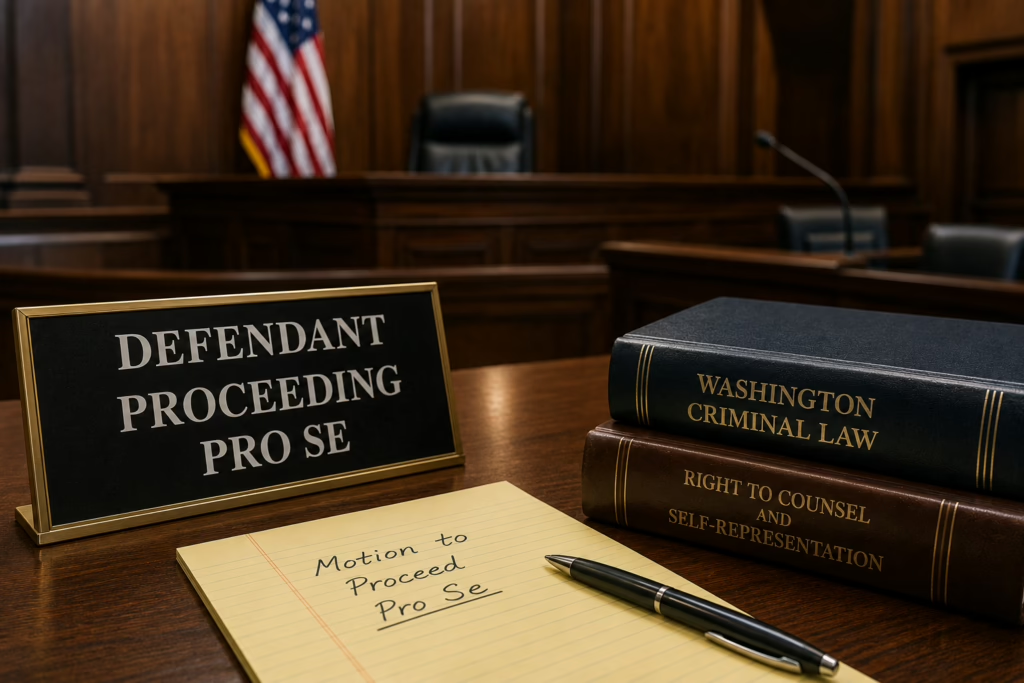
The Washington right to self-representation allows a criminal defendant to give up the assistance of an attorney and represent himself or herself in court. But because the right to counsel is fundamental, a judge cannot accept that decision casually. The defendant’s request must satisfy specific constitutional requirements before a criminal case can proceed without defense counsel.
The recent Washington Court of Appeals decision State v. Sims, No. 86521-8-I, provides a detailed example. Joseph Sims initially told the trial court that he felt “forced” to represent himself because of problems with his attorneys. The judge declined to accept that initial request. Weeks later, however, Sims filed a new motion expressly stating that he wanted to proceed pro se. After another extensive inquiry, the court allowed him to represent himself.
Following convictions for numerous serious offenses, Sims argued on appeal that the trial court actually violated his right to counsel by granting his own request to represent himself.
Division One rejected that argument and affirmed.
Importantly, Sims is an unpublished opinion. It does not establish binding Washington precedent. The controlling principles concerning self-representation come from the United States and Washington constitutions and published decisions of the United States Supreme Court and Washington Supreme Court.
The Constitutional Right to Represent Yourself in a Criminal Case
A criminal defendant has a constitutional right to an attorney under the Sixth Amendment to the United States Constitution and article I, section 22 of the Washington Constitution.
But the right to counsel has a counterpart: a competent defendant generally has a constitutional right to reject counsel and conduct his or her own defense.
The United States Supreme Court recognized that right in Faretta v. California, 422 U.S. 806 (1975). The Washington Supreme Court has likewise recognized a criminal defendant’s right to self-representation. See State v. Madsen, 168 Wn.2d 496, 503, 229 P.3d 714 (2010).
These two constitutional protections create an unusual tension.
A court must protect a defendant’s right to an attorney. At the same time, the court cannot force counsel on a defendant who has validly exercised the constitutional right to proceed without one.
Washington Right to Self-Representation Requires a Two-Step Inquiry
The Washington Supreme Court explained the governing analysis in State v. Curry, 191 Wn.2d 475, 423 P.3d 179 (2018).
When a defendant asks to represent himself, the trial court conducts a two-step inquiry.
First, the request must be timely and unequivocal.
Second, if it is timely and unequivocal, the court determines whether the waiver of counsel is voluntary, knowing, and intelligent.
These requirements protect both sides of the constitutional equation. Courts must respect a genuine decision to proceed pro se while protecting defendants against accidental, impulsive, or misunderstood waivers of the right to an attorney.
What Does an “Unequivocal” Request Mean?
A request is unequivocal when it reflects an explicit choice between representation by an attorney and self-representation.
The Washington Supreme Court has explained that this requirement helps protect defendants from capriciously waiving counsel while also preventing manipulation through repeated changes in position about representation.
There is no simple phrase that automatically makes every request unequivocal.
Instead, Washington courts examine the entire context.
In Curry, the Supreme Court identified relevant considerations including how the request was made, the language the defendant used, and the circumstances surrounding it.
For example, a judge may consider whether the defendant filed a formal motion or simply made a frustrated remark during a hearing. The court may also consider whether the request resulted from a disagreement about trial strategy, dissatisfaction with an attorney, or some other circumstance.
That contextual analysis became particularly important in Sims.
Why the Judge Initially Refused to Let Sims Represent Himself
Sims first filed a “Motion to Dismiss Counsel” in April 2022.
During the May hearing, he complained about his assigned attorney and expressed concern about which lawyer might be appointed next. He believed attorneys would not file approximately 19 motions he wanted filed.
At one point, Sims told the judge that he felt he was being “forced to go pro se” to obtain the results he wanted.
The trial court did not immediately grant the request.
Instead, the judge conducted an extensive discussion with Sims concerning the consequences of self-representation. Among other things, the judge addressed the seriousness of the charges, difficulties associated with representing oneself while incarcerated, the absence of any guarantee of standby counsel, and the fact that Sims would be held to the same standards applicable to an attorney.
The judge then focused on a critical distinction: Did Sims actually want to represent himself, or did he simply not want certain attorneys representing him?
Sims acknowledged that dissatisfaction with potential counsel was at least part of what was driving his decision.
He eventually told the judge:
“I don’t want to proceed pro se. I feel like I have to proceed pro se.”
The trial court was not convinced that this amounted to an unequivocal waiver of counsel.
Rather than allowing Sims to proceed alone, the judge ordered reassignment of counsel.
That decision demonstrates the caution courts must exercise before accepting a waiver of a fundamental constitutional right.
Sims Later Made an Explicit Request to Represent Himself
The situation changed after new counsel was appointed.
On May 27, Sims filed a handwritten “Affidavit and Motion to Proceed Pro Se.”
The wording of this second request was much different.
According to the Court of Appeals, Sims wrote:
“I now make an affirmative and unequivocal request to go Pro-Se.”
At the subsequent June 10 hearing, Sims told the judge that his goal was to make it affirmatively and unequivocally clear that he chose to represent himself.
He also stated:
“I believe in this case I can best represent myself.”
The judge again addressed the difficulties associated with self-representation.
Sims confirmed that he understood the warnings previously given to him, had spent time considering his decision, and still wanted to proceed without an attorney.
He also signed a written waiver of his right to counsel.
The trial court then granted the motion.
Dissatisfaction With an Attorney Does Not Automatically Make the Request Equivocal
One of the most useful points illustrated by Sims is that a request for self-representation does not automatically become equivocal merely because dissatisfaction with an attorney helped motivate it.
The Washington Supreme Court addressed that issue in Curry.
A defendant may be frustrated with counsel, a requested continuance, defense strategy, or other circumstances and still ultimately make a clear constitutional choice to represent himself.
The question is whether, considering the record as a whole, the defendant actually made an unequivocal choice.
That is why the two requests in Sims produced different outcomes.
His first request was intertwined with complaints about counsel and statements that he did not actually want to represent himself.
His second request followed additional time for consideration, appointment of new counsel, a written motion specifically requesting self-representation, and unequivocal statements that he believed he could best represent himself.
Knowing, Intelligent, and Voluntary Waiver of Counsel
An unequivocal request alone is not enough.
Before permitting Washington right to self-representation, the trial court must also determine that the defendant’s waiver of counsel is knowing, intelligent, and voluntary.
An on-the-record colloquy is generally used to establish that understanding.
The purpose is not to determine whether self-representation is a good idea. A defendant can make a decision the judge considers unwise and still possess the constitutional right to make it.
Instead, the inquiry helps establish that the defendant understands what is being surrendered and the risks associated with proceeding without an attorney.
In Sims, the Court of Appeals noted that the trial judge engaged in extensive colloquies with Sims.
The judge discussed the right to a court-appointed lawyer, the difficulties of self-representation, the ways an attorney could assist him, his potential sentencing exposure, and the practical difficulties of preparing a defense from jail.
The judge repeatedly checked whether Sims understood.
Sims said that he did.
He also confirmed that his decision was voluntary, reviewed the written waiver with newly appointed counsel, stated that he understood his rights, and signed the waiver.
Notably, Sims did not argue on appeal that his waiver was unknowing, unintelligent, or involuntary. His appellate argument focused on whether his request had really been unequivocal.
Representing Yourself Does Not Mean the Judge Becomes Your Lawyer
A defendant considering self-representation should understand an important practical consequence: the trial judge does not become substitute defense counsel.
In Sims, the judge specifically warned him that the court would not assist him and that he would be held to the same standards as an attorney.
Self-representation can require dealing with evidentiary rules, witness examinations, objections, motions, jury instructions, constitutional issues, trial strategy, preservation of appellate issues, and procedural deadlines.
Being unfamiliar with those rules generally does not eliminate the consequences of failing to follow them.
The constitutional right to proceed pro se is therefore very different from a right to receive legal assistance from the court while conducting one’s own defense.
What About Standby Counsel?
Sims’s case also illustrates the role of standby counsel.
Months after obtaining permission to represent himself, Sims requested standby counsel. The trial court granted the request.
Later, Sims asked the court to remove standby counsel.
During those proceedings, the judge again reminded Sims that he could withdraw his waiver and return to representation by counsel.
Sims declined.
At one point, after the judge suggested that the wiser course would be to take back his waiver, Sims responded that he would “pass again for the fifth or sixth time.”
Later, when asking to remove standby counsel, Sims stated that he had been representing himself for approximately a year and a half and stood firmly by that choice.
Those later statements were not what made the original waiver valid. The Court of Appeals specifically recognized that a trial court cannot justify an earlier finding of unequivocation based on future events that were unknown when the decision was made.
But they demonstrate how firmly Sims continued to maintain his decision after the court granted his request.
Can a Defendant Change His Mind About Self-Representation?
The Sims proceedings also demonstrate that a defendant’s position regarding representation can evolve.
The trial judge did not treat Sims’s uncertain first request as permanently resolving the question.
Instead, the court told him that he could make another motion later.
He did.
When Sims returned with a more explicit request after considering the issue and consulting with newly appointed counsel, the judge conducted another inquiry.
This illustrates why Washington courts examine the circumstances existing when the particular request is made rather than applying a mechanical rule based solely on something the defendant said earlier in the case.
Why the Court of Appeals Upheld Sims’s Self-Representation
On appeal, Sims made an unusual constitutional argument: the trial court violated his right to counsel by granting his own motion to represent himself.
Division One disagreed.
Looking at the record as a whole, the court emphasized several facts:
- Sims made multiple requests to represent himself;
- his second request was contained in a written motion specifically seeking pro se status;
- the second motion expressly described the request as “affirmative and unequivocal”;
- he had time to consider the decision after his first hearing;
- he told the judge he believed he could best represent himself;
- the judge conducted extensive colloquies concerning the consequences;
- Sims signed a written waiver of counsel; and
- the record demonstrated more than a spontaneous expression of frustration with an attorney.
The Court of Appeals therefore concluded that the trial judge did not abuse his discretion by determining that Sims’s second request was unequivocal.
State v. Sims Is an Unpublished Opinion
There is an important limitation on the legal significance of State v. Sims: Division One designated the decision as unpublished.
An unpublished Washington Court of Appeals decision does not have the same precedential authority as a published appellate opinion.
Washington GR 14.1 — Citation to Unpublished Opinions governs citation of unpublished opinions.
Under GR 14.1, qualifying unpublished Washington Court of Appeals opinions filed on or after March 1, 2013 may be cited as nonbinding authority when the requirements of the rule are satisfied.
Sims Is Illustrative, Not Binding Precedent
That distinction matters for this article.
It would be inaccurate to say that Sims created a new binding rule governing the Washington right to self-representation.
Instead, Sims illustrates how one Court of Appeals panel applied existing precedent to a detailed record involving two different requests for self-representation.
The principal rules discussed in the opinion come from binding or precedential authorities including Faretta v. California, State v. Madsen, and State v. Curry.
In particular, the Washington Supreme Court’s published decision in Curry provides important guidance concerning whether a request for self-representation is unequivocal.
Thus, Sims is useful because of its factual illustration, but lawyers and courts should look to the applicable constitutional provisions and published appellate authority for the controlling legal rules.
What Sims Teaches About the Washington Right to Self-Representation
The most important lesson from Sims is that a defendant’s right to represent himself and the right to counsel must both be taken seriously.
A frustrated statement such as “I guess I’ll represent myself” is not necessarily enough to waive counsel.
But dissatisfaction with an attorney does not permanently prevent a defendant from choosing self-representation either.
The court must evaluate the actual request in context.
When a defendant makes a timely and unequivocal request and knowingly, intelligently, and voluntarily waives counsel after understanding the risks, the constitutional right to self-representation can require the court to allow the defendant to proceed without an attorney—even when the judge believes doing so is a poor strategic decision.
That makes the waiver-of-counsel inquiry exceptionally important.
Speak With a Washington Criminal Defense Attorney
Choosing whether to proceed with an attorney or represent yourself can have consequences throughout a criminal case. Criminal trials involve rules of evidence, constitutional issues, motions, witness examinations, jury instructions, sentencing law, and preservation of issues for appeal.
A person considering giving up the right to counsel should understand both the constitutional right to self-representation and the practical consequences of proceeding without trained defense counsel.
Contact Blanford Law today at ken@blanfordlaw.com or 253-720-9304 for guidance on your legal matter.
Additional Resources
Washington Self-Representation Case
Learn how Washington courts evaluate a criminal defendant’s request to proceed pro se and the constitutional requirements that must be satisfied before a defendant may represent themselves.
Waiving the Right to Counsel in Washington
Explore what Washington courts require before accepting a waiver of counsel, including whether the defendant’s decision is unequivocal, knowing, intelligent, and voluntary.
Washington Felony Harassment and the Right to Counsel
Read about the right to counsel in a Washington felony harassment case and why properly protecting—or waiving—that constitutional right can become an important appellate issue.
Washington RPC 4.2: Communicating With a Represented Person
Learn how Washington RPC 4.2 regulates a lawyer’s communications with a person known to be represented by another attorney and the circumstances in which communication may be permitted.
Washington CrR 3.1: Right to and Assignment of Counsel
Review Washington CrR 3.1 and the rules governing a criminal defendant’s right to an attorney, appointment of counsel, and representation during criminal proceedings.